Mary Magdalene
She was one of Jesus’s closest followers, the first witness to the Resurrection, and remains one of Christianity’s most famous saints. But she was also a former prostitute, a repentant sinner, and a penitent who withdrew to the desert: no other biblical figure embodies so many contradictions as Mary Magdalene.
Representations of Mary Magdalene have reflected evolving cultural and religious ideas, ranging from the Gospels of the New Testament to medieval legends, from political propaganda to discussions about femininity and gender roles.
Works by artists such as Albrecht Dürer, Claude Lorrain, Titian, Elisabetta Sirani, Arnold Böcklin, Max Beckmann, and Kiki Smith have shaped the multifaceted image of the saint. 2,000 years on, her story remains as fascinating as ever.
Storytelling
The story of Mary Magdalene is over 2,000 years old, yet it still has the power to captivate – even recent pop icons have fallen under her spell.
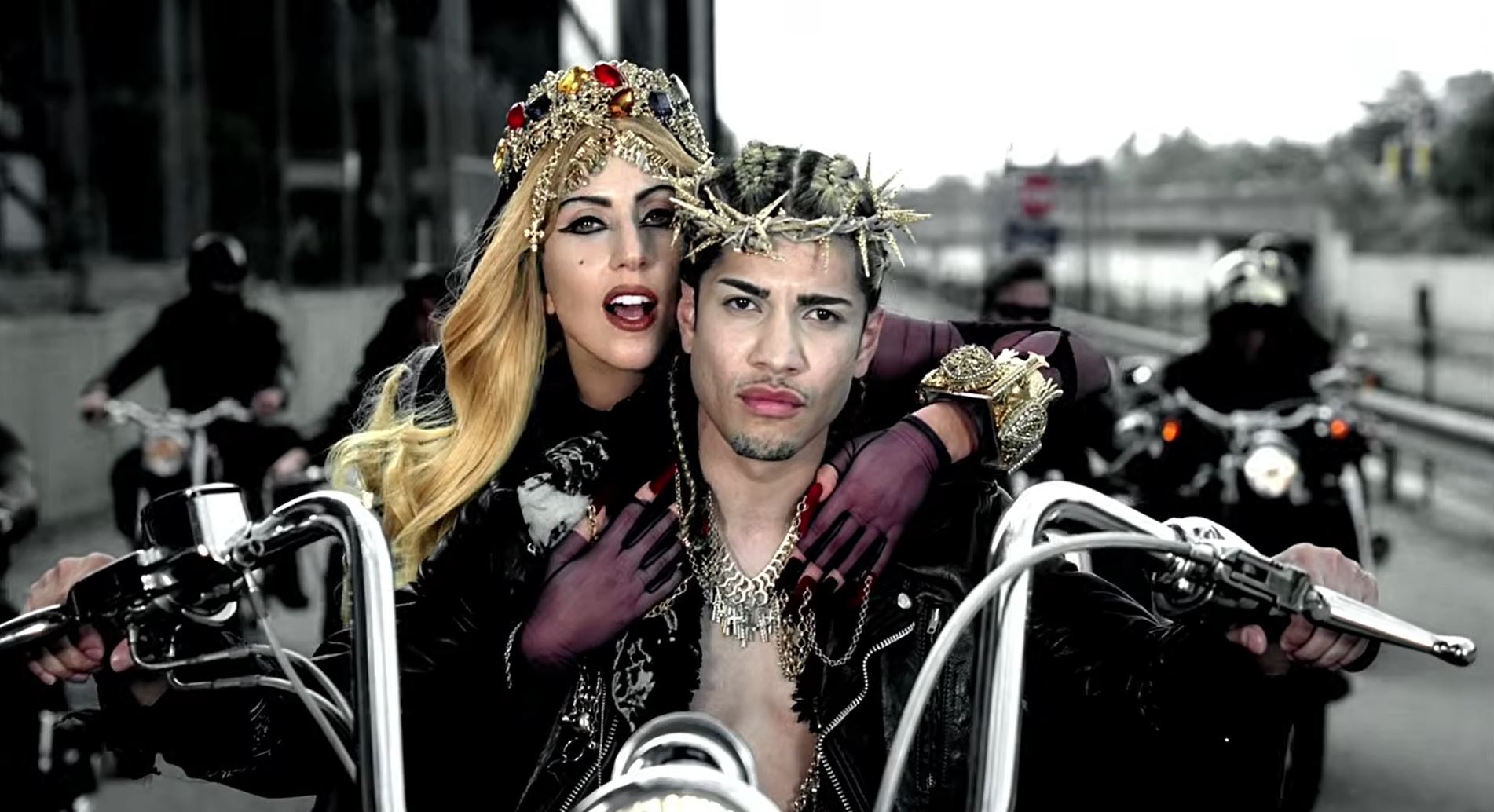
Sensual, provocative, powerful, and self-assured: these are the qualities with which the US pop star Lady Gaga (b. 1986) imbues Mary Magdalene.

“I was fascinated by her growing up, because she was seen as this harlot that was essentially Jesus’s girlfriend and she washed the feet of Christ. She’s in so much iconography, she has an iconic existence, and she’s so important.”
Lady Gaga, 2022
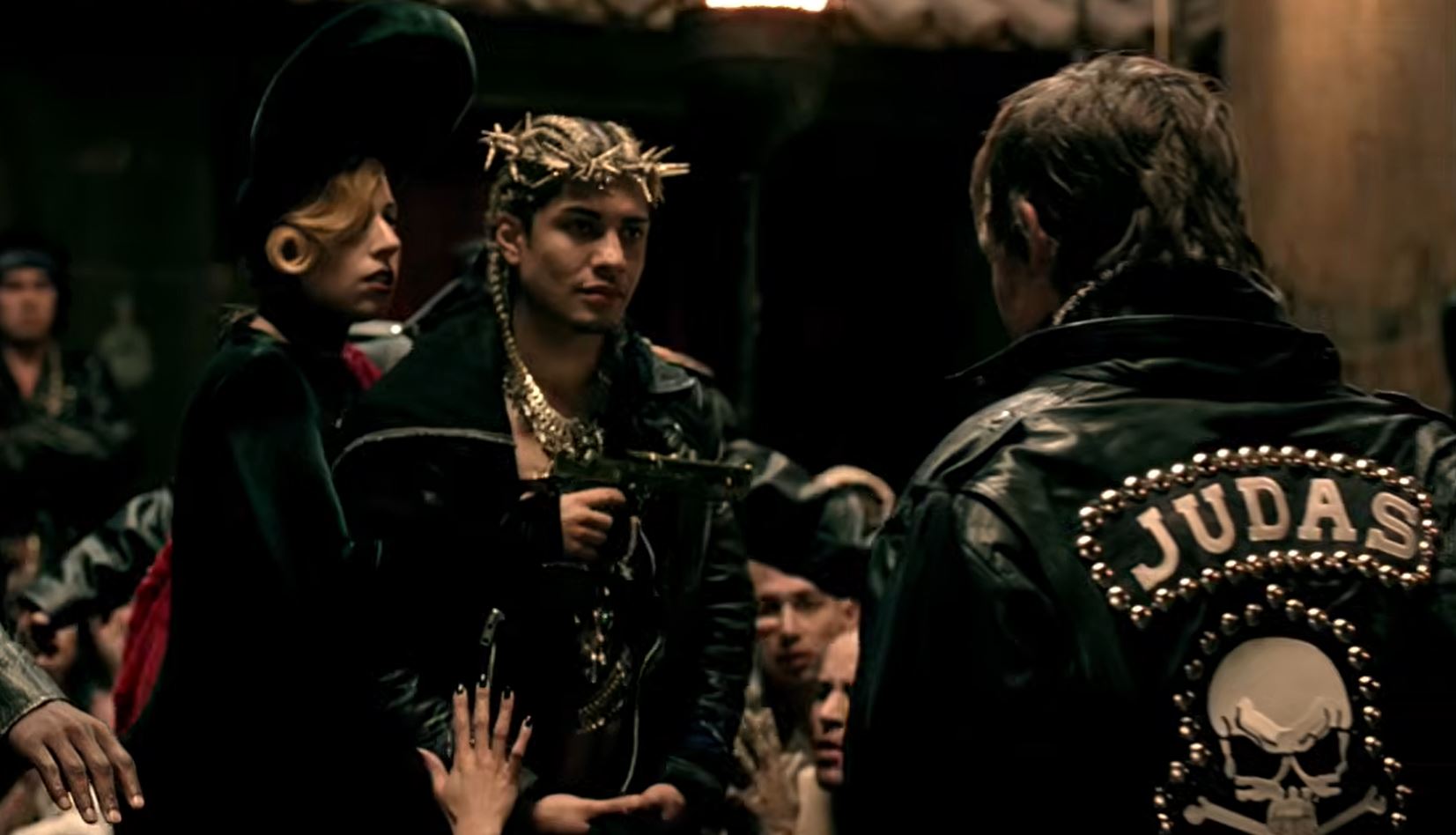
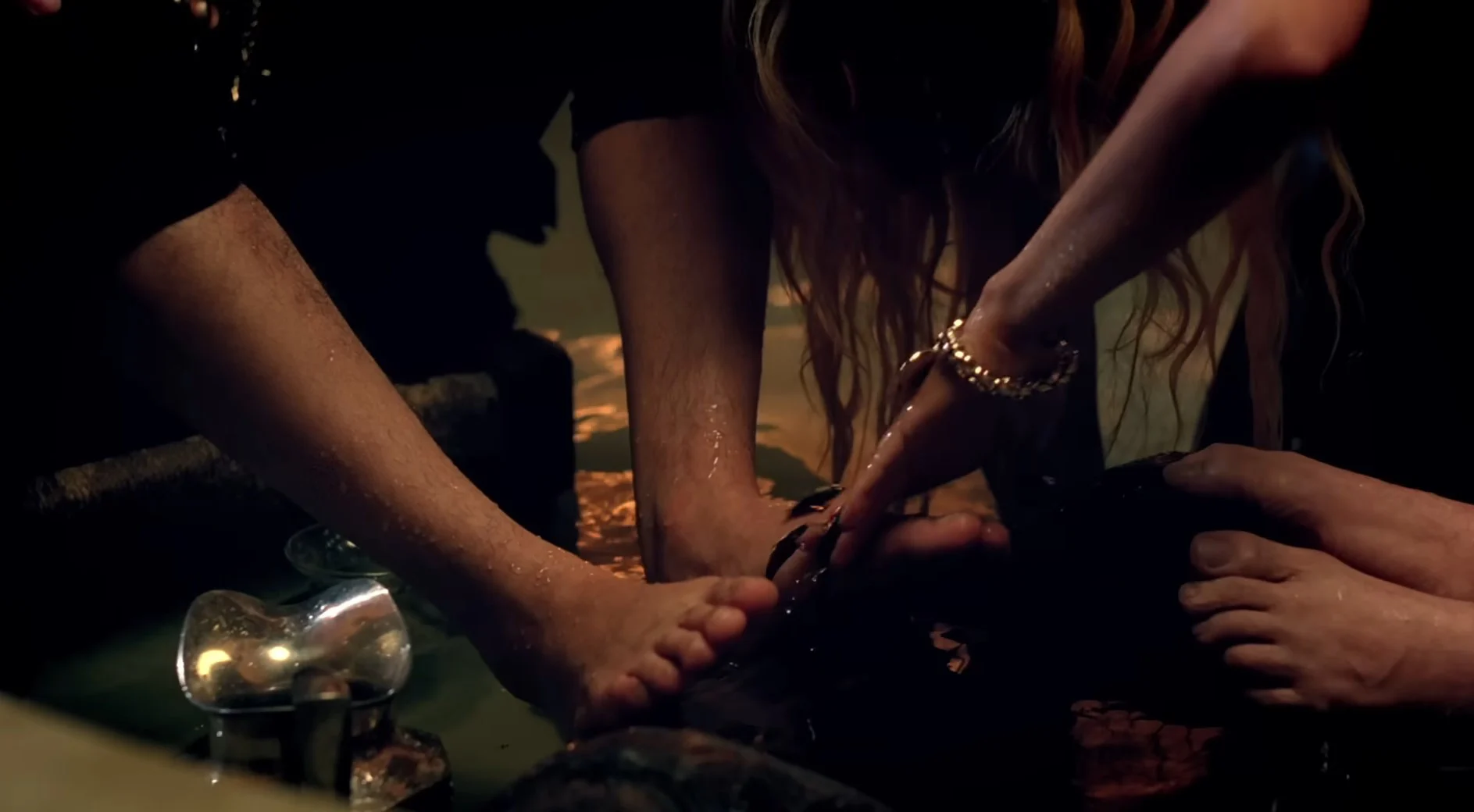
In her music video for Judas, the singer rides a freeway as part of an outlaw biker gang. The gang members boldly display their names – Philip, Thomas, and Simon – on their leather jackets. Jesus appears as their leader – always accompanied by Mary Magdalene.
VIVID NARRATIVE


VIVID NARRATIVE
A modern take: Lady Gaga weaves together biblical accounts, age-old legends, and contemporary interpretations of Mary Magdalene into a completely fresh, episodic narrative.
An erotic depiction of the washing of the feet is followed by an emotionally charged love triangle. In the video, Mary Magdalene seeks intimacy with Jesus, yet also feels drawn to Judas. That very night, Judas will betray Jesus to the Roman soldiers
A New Religion
According to the Gospel of Mark, a furious Jesus drove the merchants out of the temple in Jerusalem. As a Jewish wandering preacher, he objected to commerce in the house of the Lord. He reached out to the poor and outcast, preaching a new faith based on unconditional love of one’s neighbour.
Jesus’s growing following did not escape the attention of the Roman authorities occupying the areas around Judea and Galilee. Fearing an uprising during the Jewish festival of Passover, they arrested him. The Roman governor Pontius Pilate sentenced him to death. The crucifixion marks the beginning of the Easter story, in which Mary Magdalene plays a central role of bearing witness.
These momentous events were recorded in the four Gospels of the New Testament around 2,000 years ago. However, the accounts of Matthew, Mark, Luke, and John differ in certain details.
The stories that have grown up around Mary Magdalene over the centuries still shape how we see this intriguing female figure in Christianity today.
Lady Gaga reimagines the saint and what we think we know about her for our time. Mary Magdalene is said to have anointed Jesus’s feet, and thus had direct physical contact with the Saviour. The Gospels describe how she was present at his crucifixion and discovered his empty tomb soon afterwards. As his closest confidante, she was the first to witness the Resurrection and was tasked with informing his disciples of the miracle.
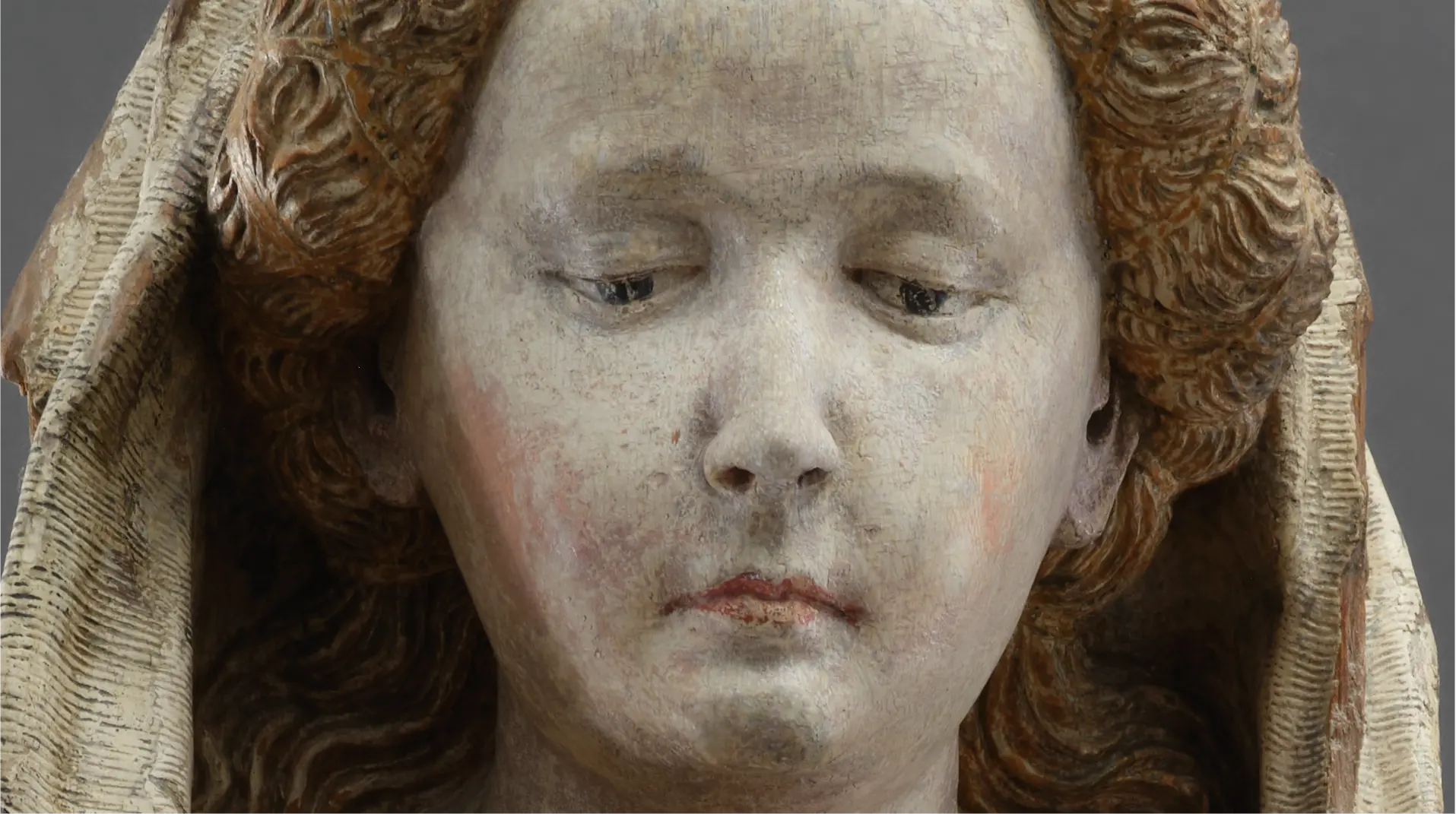
Mary Magdalene is usually portrayed as young, blonde, and with flawless features. In fact, no sources provide any information about her age or appearance. However, her name alone suggests something interesting.
The Secret Behind Her Name
During Jesus’s lifetime, “Mary” was one of the most popular names for women. Women with this name were distinguished by epithets referring to their male relatives. In the case of Mary Magdalene, however, her name probably refers to her place of origin: Mary of Magdala, a prosperous fishing town on the shores of the Sea of Galilee. No evidence has yet been found, however, to suggest that the town, now known as Migdal, was already called Magdala in the 1st century.
However, Jesus had also given male apostles epithets with specific meanings: Simon, for example, he called “Cephas” (Greek: petros), meaning “rock” in English. Therefore, Jerome (c. 348/49–420), one of the four Fathers of the Latin Church, translated the epithet, derived from Aramaic and Hebrew, literally as “tower” or “fortress”. Was this an allusion to her farsighted, visionary powers? What is certain is that to this day, Mary Magdalene came to be interpreted as a steadfast pillar of the Christian faith. She is said to have stood by Jesus at the cross with unwavering courage, and she was chosen by Jesus to proclaim the “Good News.”
Apostle
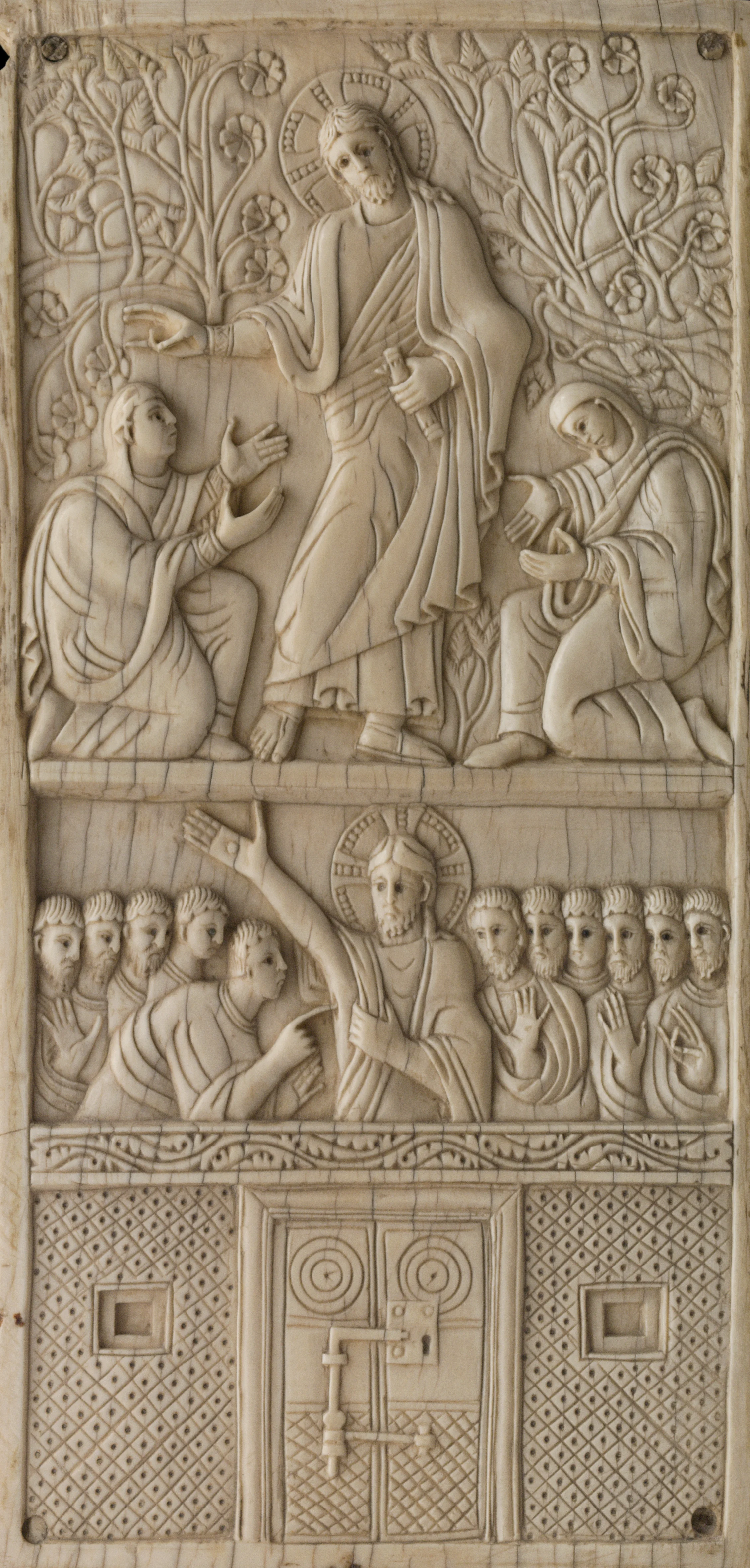
Jesus appears to her first: following the crucifixion, Mary Magdalene becomes the first witness to, and herald of, his Resurrection. This elevated status is reflected in ecclesiastical art, where she stands out among the male apostles.
Jesus initially referred to his twelve male disciples as “apostles”, which means “messengers” or “envoys”. Yet after his resurrection, he chose to appear to Mary Magdalene before anyone else. She was to proclaim the “Good News”, and as the first one to bear tidings of the new faith, she later became known as the “apostle of the apostles”.
The message
Having risen from the dead, Jesus holds a scroll in his left hand to symbolise the Christian message that God conveys to humanity through him. He first entrusts Mary Magdalene with the task of spreading this message.
The first encounter
In her pivotal role, Mary Magdalene kneels directly beside the risen Christ, alongside an unknown woman described simply as “the other Mary”, as recounted in the Gospel of Matthew.
The reunion
Further down the panel, in a noticeably smaller scene, Christ appears to the male apostles only after his encounter with Mary Magdalene.
The hiding place
Following Jesus’s condemnation, as recounted in the Gospel of John, the male apostles hide behind locked doors, hoping to escape punishment themselves.
This small, finely carved ivory plaque depicting Mary Magdalene is striking. In the Early Middle Ages, such imagery was primarily found on precious objects, such as reliquaries containing the remains of saints, in illuminated manuscripts, or on other liturgical items.
However, it was the late-medieval church interior that brought these elements together in an orchestrated whole: devotional images, sculptures, and reliefs made the saints’ presence visually tangible throughout the space, emphasising the special significance of Mary Magdalene as an apostle.

Elevated by angels and slightly larger than the other figures, Mary Magdalene appears among the elaborately gilded apostles. While the male apostles wear richly draped robes, she is enveloped by just her long hair.
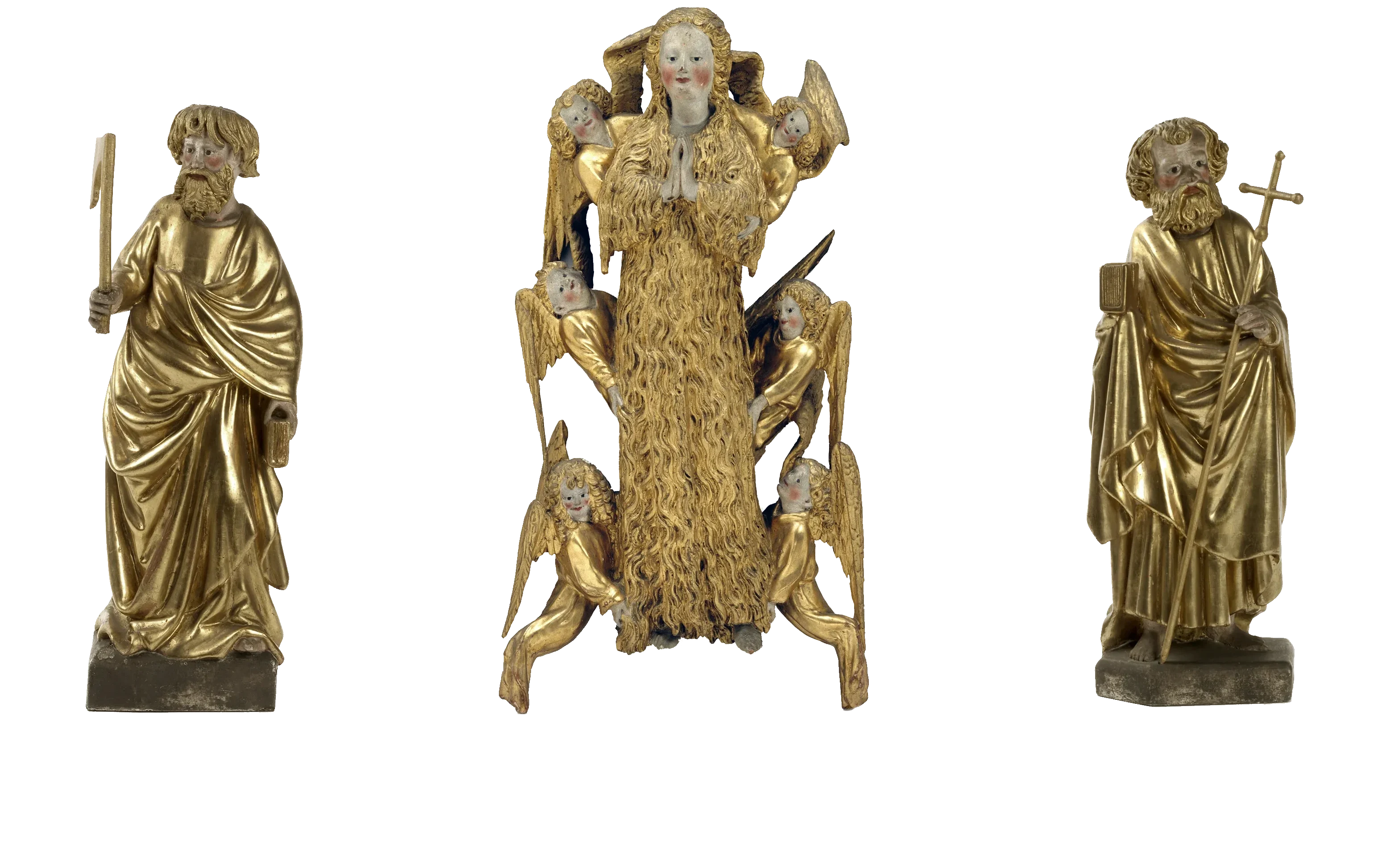
Artistic depictions of Mary Magdalene are based on various sources. In the Bible, however, only the following is reported: after Jesus casts seven demons out of her, Mary Magdalene supports him as a faithful disciple. In the crucial hours, she proves to be a courageous witness, watching the crucifixion from afar – while the male disciples flee in fear – and becoming the first to stand before the empty tomb.
Reinvention
In a seminal moment, Pope Gregory the Great declared in the 6th century that Mary Magdalene was one and the same person as the biblical figures of Mary of Bethany and an unnamed sinner. This opened up new possibilities for her representation in art.
This carved wooden bust portrays the learned Pope Gregory the Great (c. 540–604) wearing the triple papal crown and engrossed in the Bible. The traces of polychromy and gilding give an impression of the sculpture’s original splendour. Created by Hans Bilger (1445–before 1523) in the late 15th century, the sculpture testifies to the pope’s enduring influence long after his own time.

As a key achievement, Pope Gregory the Great offered new interpretations of scripture. By doing so, he exerted a profound influence on the lives of subsequent Christians: he promoted penance as the central path to securing salvation in a turbulent era fraught with war, pestilence, and fear. By merging her with the nameless sinner and Mary of Bethany, he establishes Mary Magdalene in a new role – as a model for the sinful and repentant human being.
Both women – Mary of Bethany, mentioned in the Gospels of John and Luke, and the unnamed sinner, also mentioned in the Gospel of Luke – are said to have anointed Jesus’ feet during a feast. In the centuries that followed, these scenes became a staple of the often sumptuous imagery surrounding Mary Magdalene.
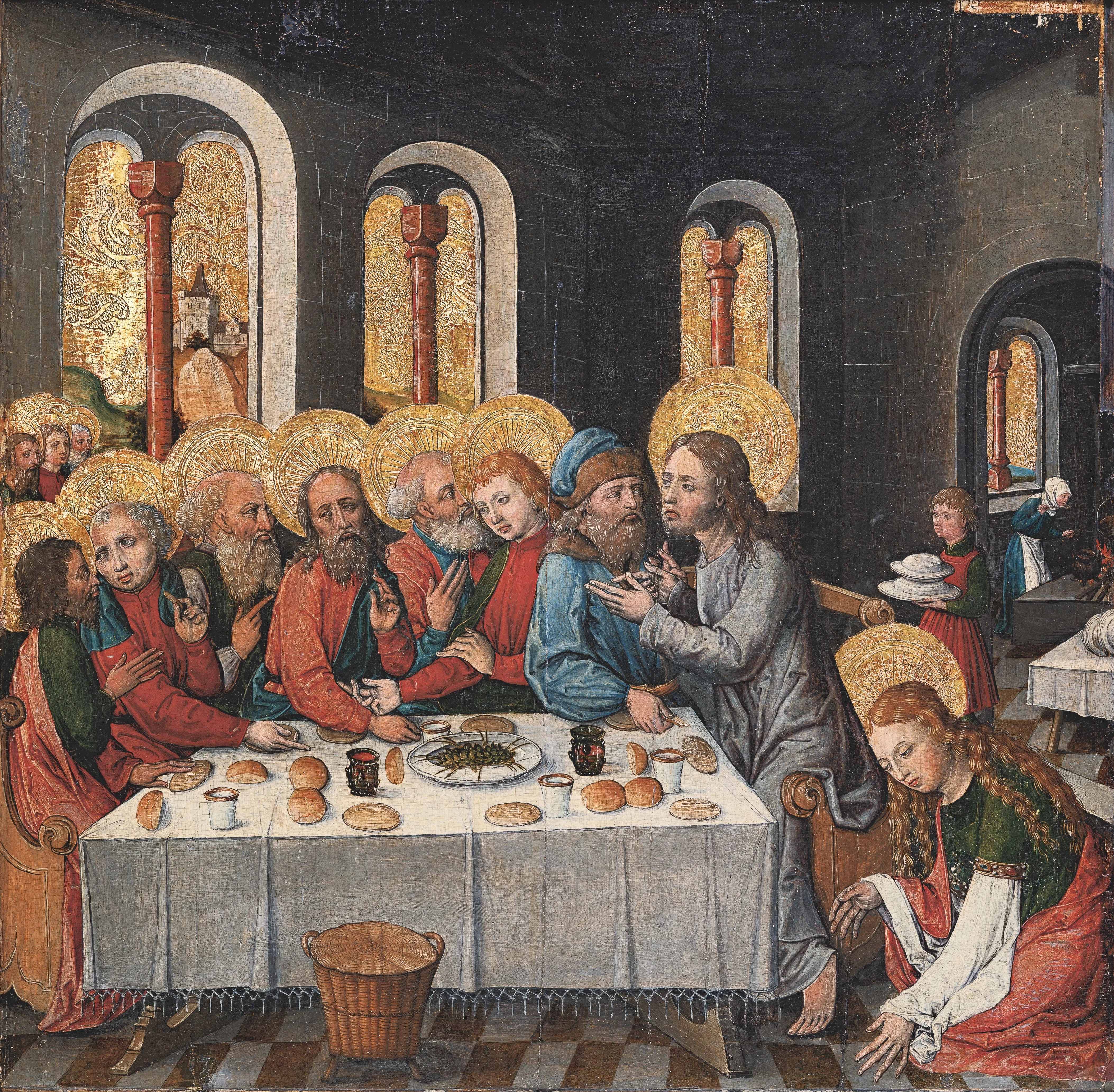
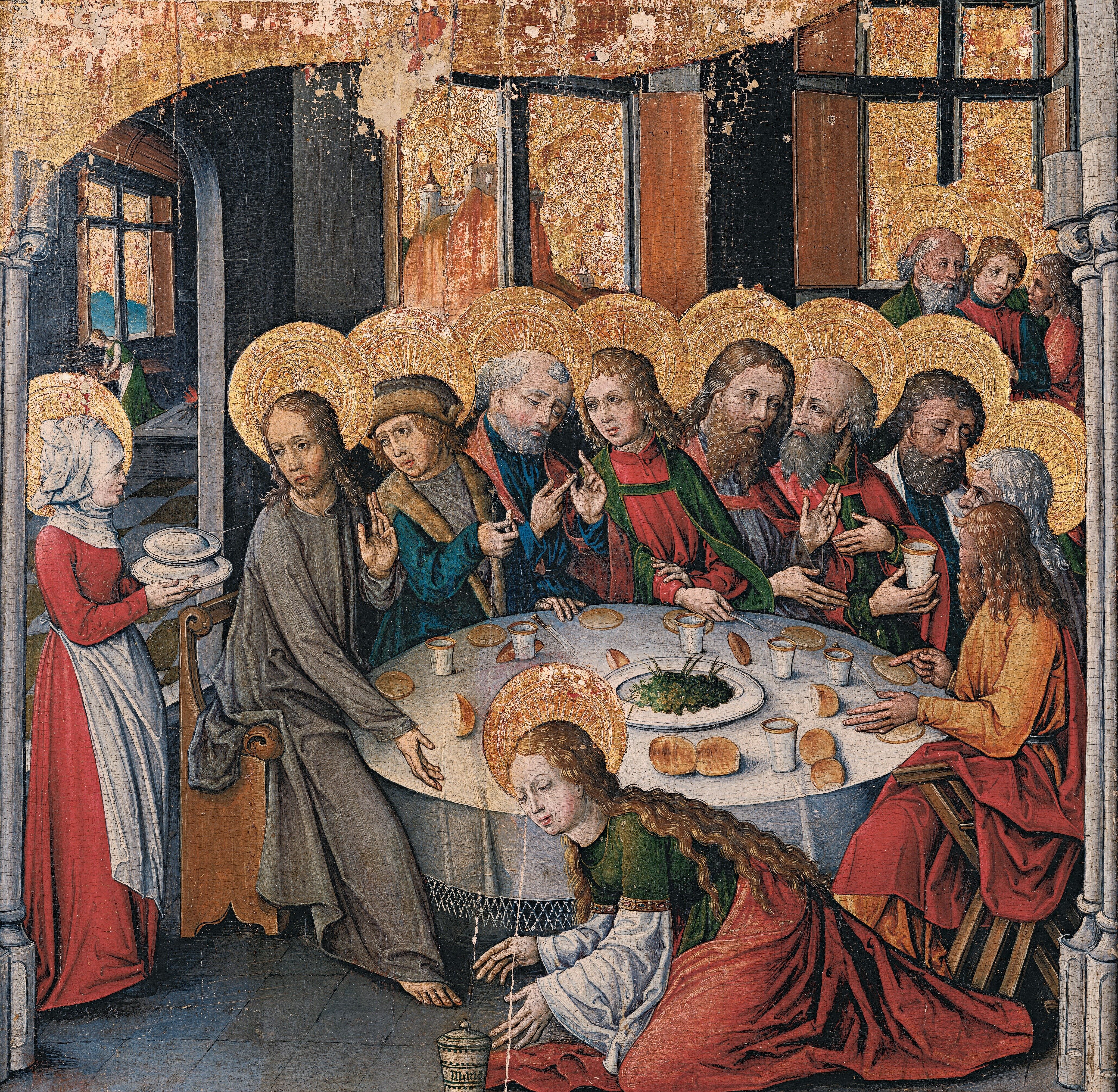
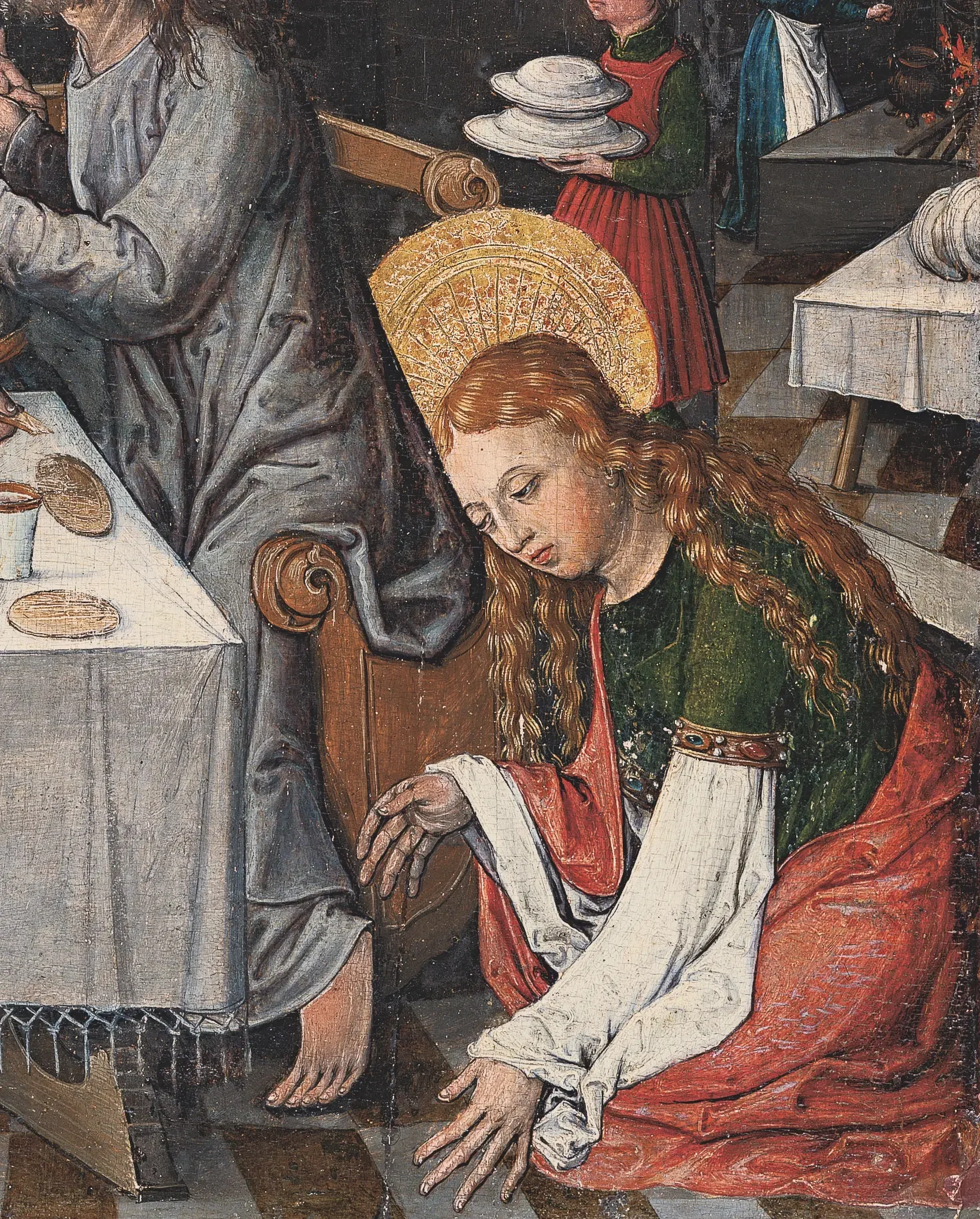
A woman kneels before Jesus and reaches for his foot. Meanwhile, the apostles are seated around a laid table, engaged in lively conversation. The two panels of a disassembled Magdalene altarpiece, created around 1500, appear very similar. However, the details reveal two different biblical scenes.
In the centuries that followed, artists repeatedly returned to the motif of the kneeling, anointing, and repentant Mary Magdalene. From then on, her religious role also came to include the forgiveness of her sins.
In the Bible, the episode involving the sinner is immediately followed by the first mention of Mary Magdalene by name. The passage describes her deliverance from seven demons, which may originally have referred to a psychological disorder. However, Pope Gregory equated these demons with the seven deadly sins, particularly worldly excess.
“How should we interpret the seven demons except as the totality of vices? […] Mary had seven demons since she was filled with the totality of vices.”
Pope Gregory the Great, Homily 33, 591 AD (trans. Dom David Hurst)
Gregory the Great understood the forgiveness of her sins as the moment of Mary Magdalene’s conversion. She thus became the Church’s model of the sinner who repents and resolves to change.
“She converted the number of her faults into the number of virtues, […]”
Pope Gregory the Great, Homily 33, 591 AD (trans. Dom David Hurst)
A Model for Confession
In 1215, Pope Innocent III (1160/61–1216) issued regulations that remain of fundamental importance to the Catholic Church to this day. The most significant of these is Canon 21, which requires all believers over a certain age to confess their sins annually at Easter. They can only receive God’s grace through Holy Communion after receiving absolution from a priest. By being a relatable figure of human fallibility, Mary Magdalene became the perfect role model as the sinner who could change her ways and be forgiven.
Legends
None of the following stories is found in any of the Gospels, yet they continue to shape how we view Mary Magdalene to this day. Growing interest in the saint gave rise to an increasing number of accounts of her life and identity.
The scenes on this intricately carved panel are immediately recognisable, yet full of fine detail. Along with its shutters, the panel was once part of a winged altarpiece dedicated to Mary Magdalene. As an object of devotion, it encouraged contemplation of the saint’s life and deeds.
The lower register first depicts biblical scenes from left to right. The upper sections of the altarpiece then show, from right to left, several episodes from widespread medieval legends.
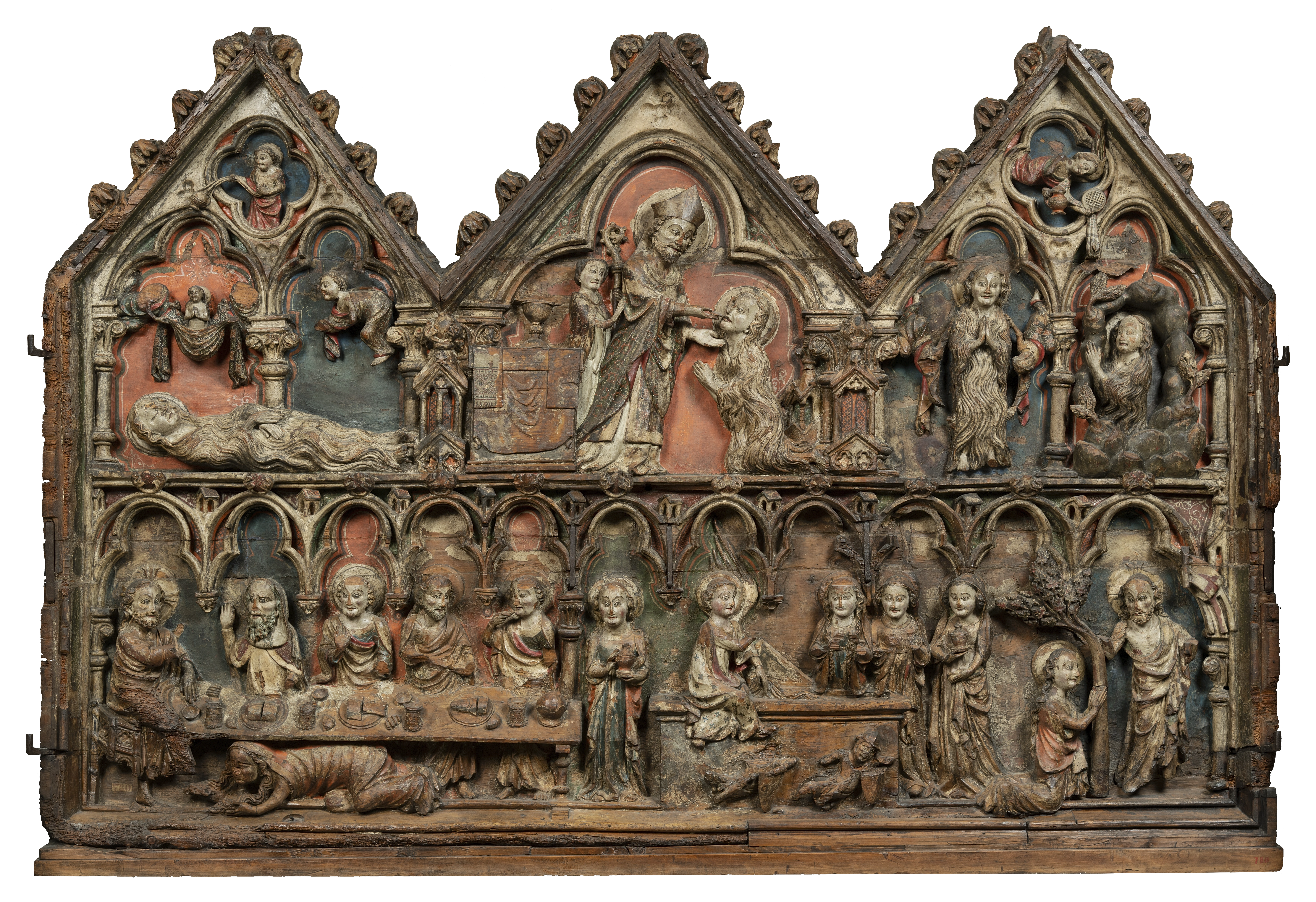
According to these legends, following Christ’s resurrection, Mary Magdalene is set adrift on a rudderless ship on account of her faith – but divine guidance brings it safely to the south of France. There, Mary Magdalene converts the pagan princely couple of Marseille to Christianity before retreating to a cave for 30 years of prayer. During this time, angels regularly carry her into heaven to receive the last rites.
At the banqueting table
The first scene shows the Feast in the House of Simon the Pharisee – with Mary Magdalene in the role of the unnamed sinner who is drying Christ’s feet with her hair before anointing them.
At the empty tomb
Early on Easter morning and accompanied by two other women, Mary Magdalene has set off for Christ’s tomb to anoint his body. On arrival, they find the tomb abandoned and an angel tells them of Christ’s resurrection.
Unexpected encounter
Here, Mary Magdalene is shown as the first witness to the Resurrection – her final appearance in the canonical texts of the Bible.
Quiet contemplation
A grotto in the Sainte-Baume mountains: On the right side of the panel, Mary Magdalene is shown retired in quiet contemplation, devoting herself to prayer. During this time, her hair grew down to her feet. Directly to the left, angels can be seen raising her up to hear their songs in heaven, constituting her sole nourishment.
Last rites
According to the legend, shortly before her death, Mary Magdalene received the Viaticum – final holy communion – from Bishop Maximin in the cathedral in Aix-en-Provence, in the south of France.
Ascension of the soul
Mary Magdalene’s lifeless body lies on the floor of the cathedral in Aix-en-Provence. Meanwhile, her soul, the small airborne figure, is carried up to heaven.
Most of the episodes are drawn from a 13th-century “legendary” or collection of saints lives, the Legenda Aurea or “Golden Legend”. Compiled by the Dominican friar and Archbishop of Genoa, Jacobus de Voragine (1228/29–1298), it was one of the most influential religious texts of the Middle Ages.
Mary Magdalene in the Wilderness
The story of Mary Magdalene’s ascetic retreat into the wilderness has its origins in the much older legend of Mary of Egypt (c. 344–c. 421/30), who is said to have spent her youth prostituting herself in Alexandria. Following a journey to Jerusalem, she converted to Christianity and renounced worldly pleasures. From then on, she lived alone in the desert on the far side of the River Jordan for 47 years, where she was eventually discovered by a hermit. An earlier account states that her clothes gradually fell apart, but that her hair had grown so long that it enveloped her entire body.
The conflation of the saintly legends of Mary Magdalene and Mary of Egypt can be traced back to 9th-century writers. The shift of the location to Provence in southern France occurred later.
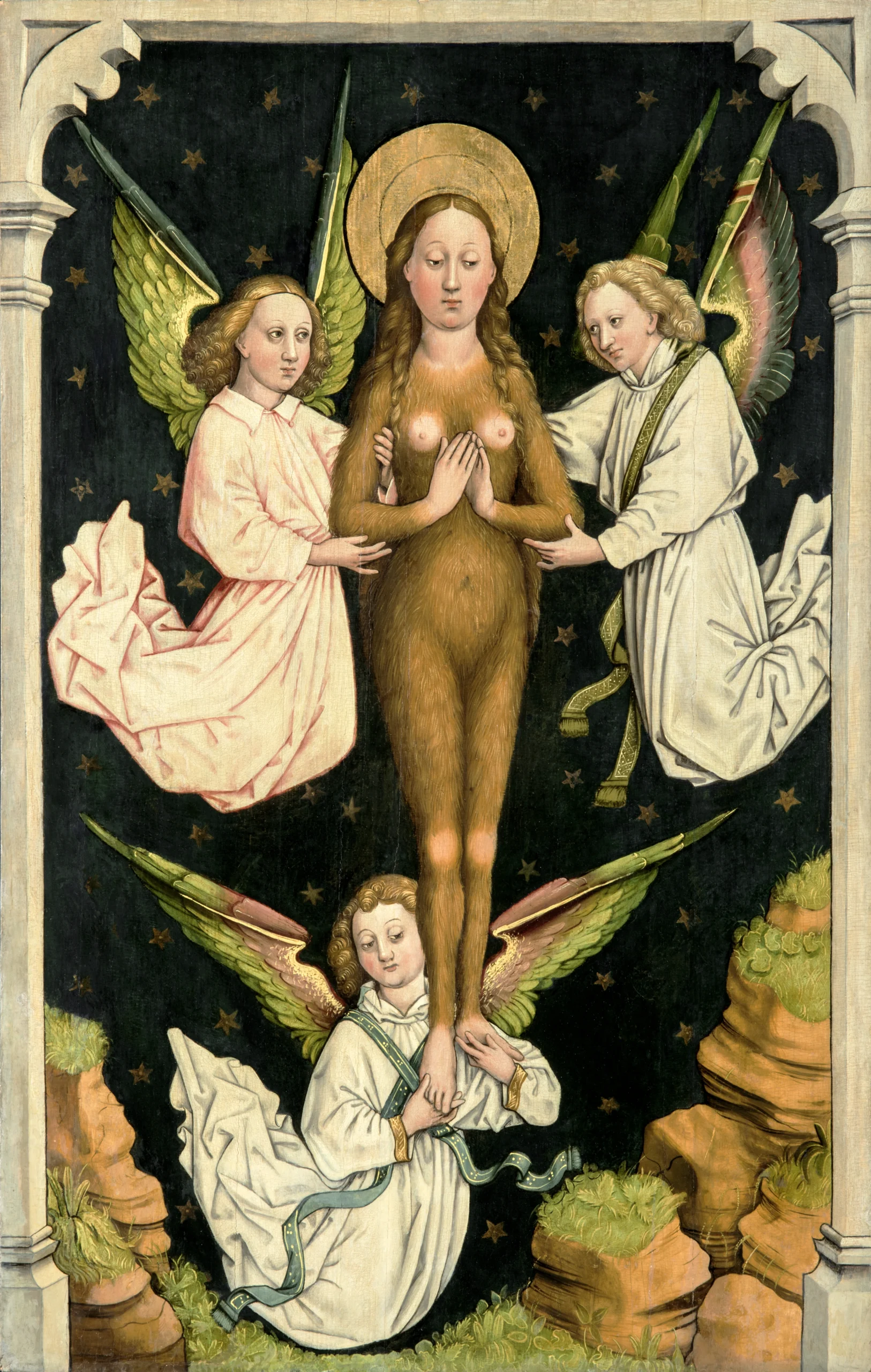

Renouncing all worldly things and retreating to a life of asceticism and penance in the wilderness. In the 13th century, the influential mendicant orders of the Dominicans and Franciscans spread rapidly across Western and Central Europe. They openly criticized the immense wealth of the Church and championed Mary Magdalene as the very embodiment of a life of penitence and self-imposed poverty.
“No other woman in the world [apart from the Virgin Mary] has been shown greater reverence or accorded greater glory in heaven.”
Humbert de Romans, Master General of the Dominican Order, 13th century
The life of Mary Magdalene is presented across at least fourteen panels of this winged altarpiece, which was commissioned by the Lübeck journeyman tailors for the Dominican church in Lübeck.
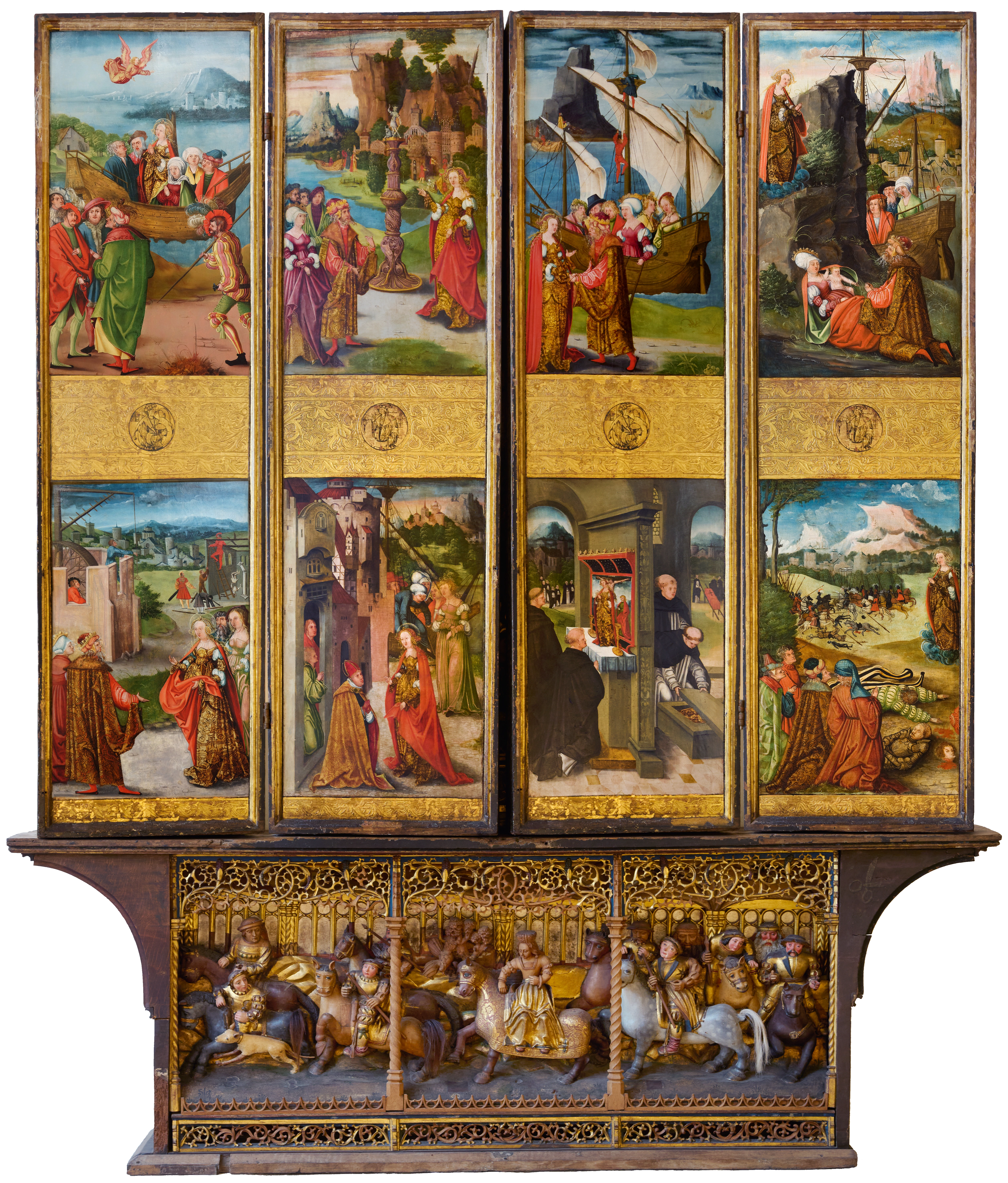
Three particularly striking panels provide insight into further episodes from the life of the saint in the south of France.

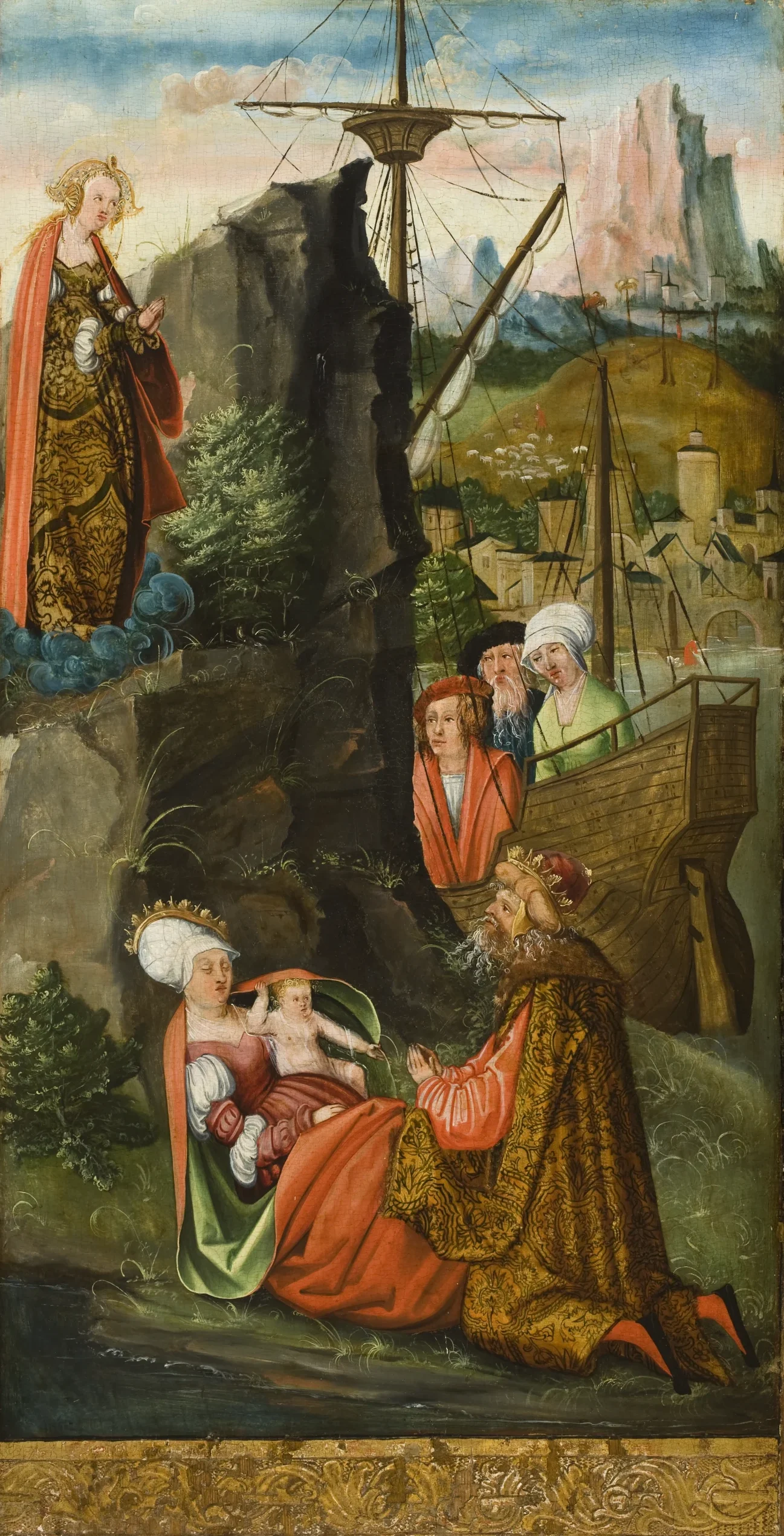
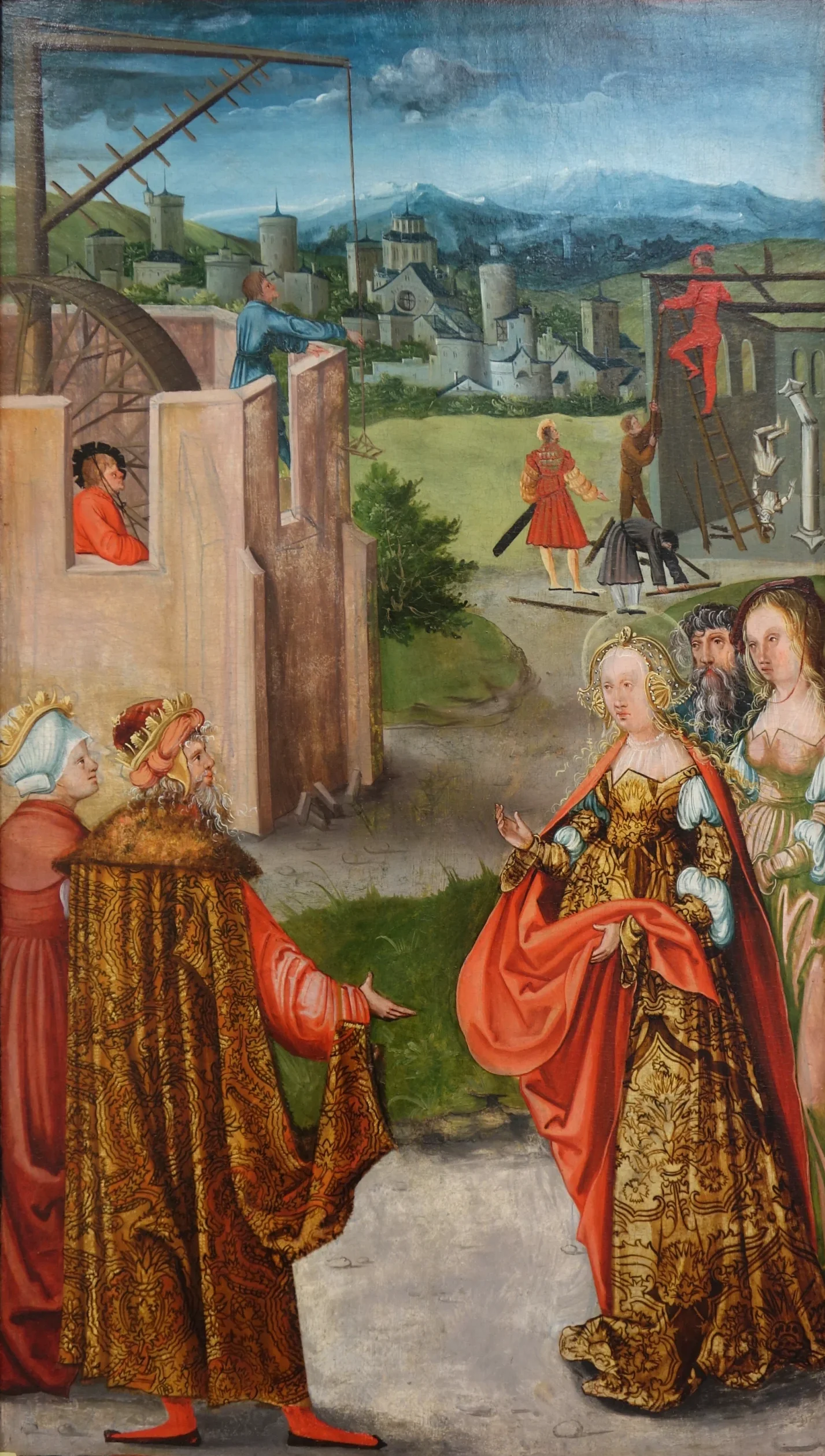
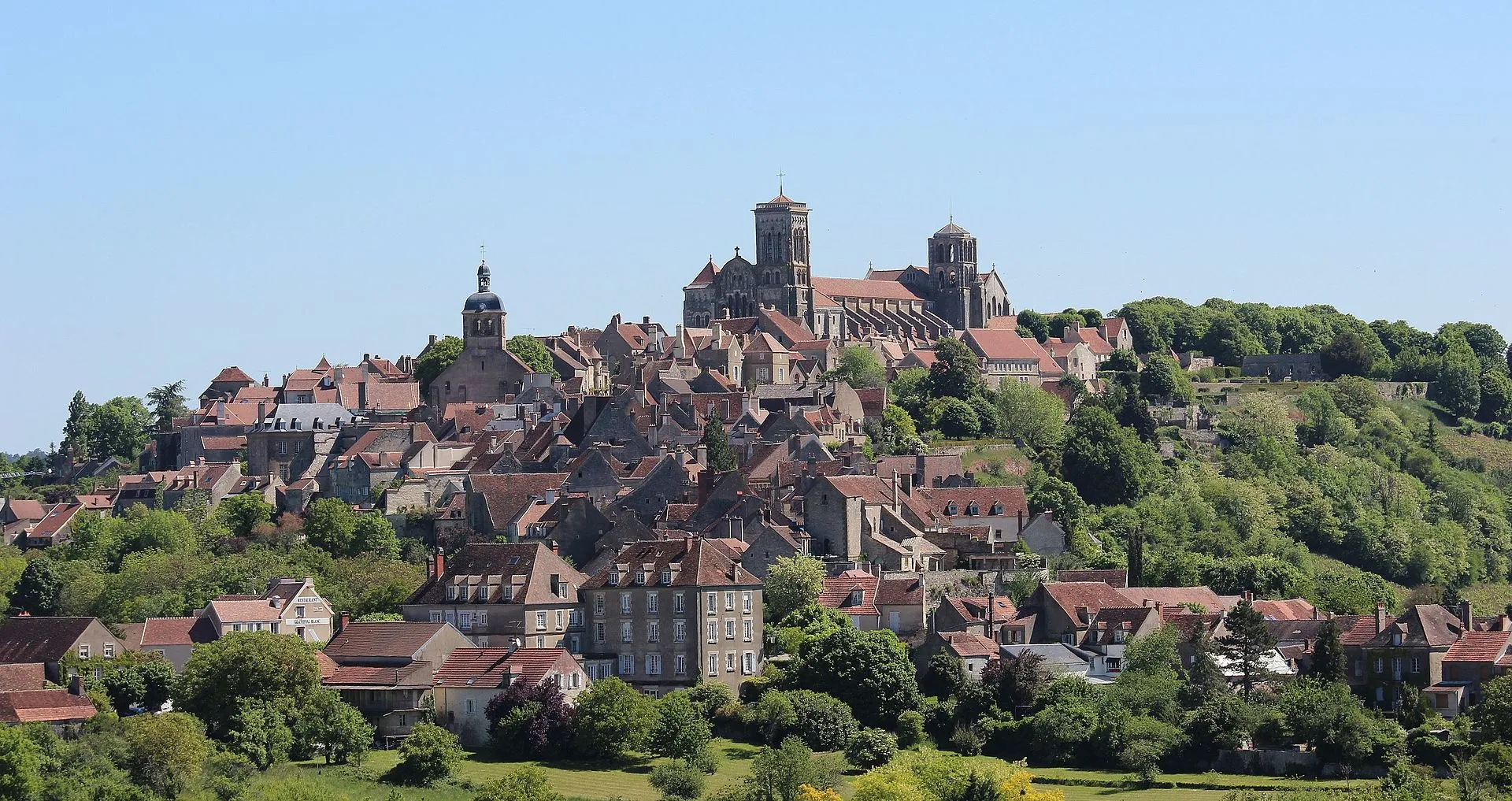
In the collective memory, the saint is firmly associated with Provence in the south of France: Mary Magdalene is henceforth regarded as the direct founder of Christianity in France. A small monastery in Vézelay, in central France, fuels the cult of Mary Magdalene even further by claiming to be in possession of her remains.
The cult of Mary Magdalene
A small monastery in Vézelay, France, fanned the flames of the cult of Mary Magdalene. Legend has it that the saint’s remains were translated from the south of France to the crypt of the monastery church in the 9th century. After the official recognition of the relics by Pope Leo IX (1002–1054) in 1050, the Burgundian town became one of France’s most important pilgrimage destinations. Pilgrims from all over Europe flocked to Vézelay to get closer to their saint – and brought great wealth and prestige to the monastery and the town.
Up close and personal
Christ on the cross – with Mary Magdalene right beside him. This type of Passion imagery grew out of Mary Magdalene’s portrayal as a role model. The saint’s loyalty and devotion are presented as exemplary and worthy of emulation by all believers.
“Now there stood by the cross of Jesus his mother, and his mother’s sister, Mary the wife of Cleophas, and Mary Magdalene.”
John 19:25
Mary Magdalene’s presence at the foot of the cross, as described in the Gospel of John, establishes her special closeness to Christ.
Dangerous proximity
During the actual crucifixion, such proximity to the condemned man would have been dangerous, bringing with it the real risk of arrest by Roman soldiers. Roman law did not exempt women from being sentenced to death by crucifixion.
This is why Matthew, Mark, and Luke all describe Mary Magdalene and the other women as witnessing the event from a safe distance. There is no mention of any male apostles being present at the crucifixion – they stayed away for fear of losing their lives.
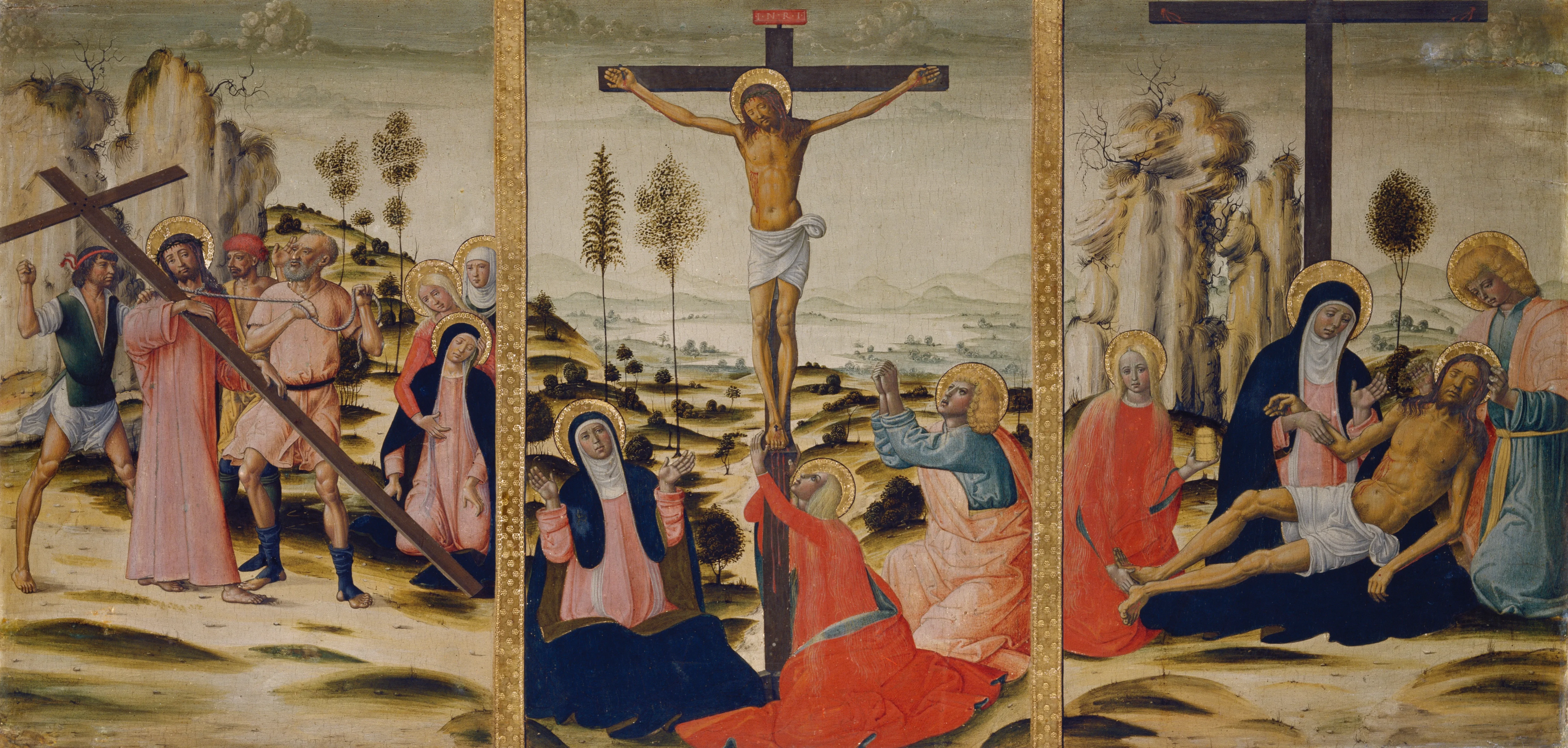
The colour of love – and of blood: Girolamo di Benvenuto (1470–1524) shows Mary Magdalene in a bright-red dress in close proximity to the crucified Christ, thus placing her at the centre of the Passion scenes. The three consecutive episodes – set in a unified landscape – reveal far more about Mary Magdalene than the Gospels do.
Courageous women
Girolamo di Benvenuto shows the strength and solidarity of these courageous women: Mary Magdalene supports the Virgin Mary. Together, they stand by Jesus as soldiers goad him to the place of execution on the hill of Golgotha.
At the foot of the cross
The painter has placed Christ’s closest confidante in a prominent position between the Virgin and John the Apostle. Kneeling, Mary Magdalene embraces the cross to be close to Christ. It almost seems as though she wants to touch his feet.
Lamentation
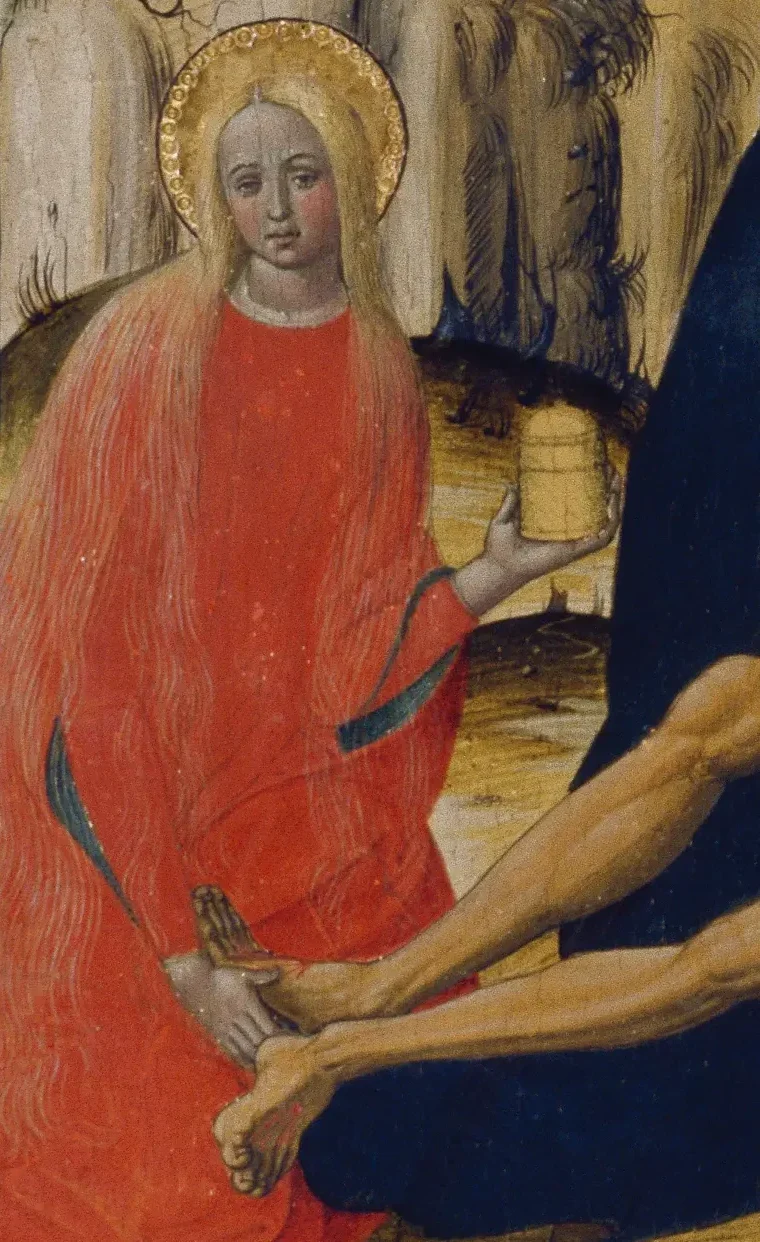
Mary Magdalene touches the feet of Christ, who has since been taken down from the cross – a scene that is not described in any of the Gospels. Yet ever since the saint’s conflation with Mary of Bethany and the unnamed sinner, the anointing of Christ’s feet has become an integral episode of the story of Mary Magdalene. At the same time, the gesture here foreshadows her ultimately unsuccessful attempt to anoint Christ’s body on Easter morning.
Precious drops
Records show that long before this biblical event, the ancient Egyptians had already succumbed to the enchanting fragrance of spikenard, an expensive essential oil. Imported from the Himalayan region of Nepal, China, and India, it was used in luxurious perfumes, pain-relieving medicines and for embalming the dead. To preserve the fragrance and active properties, it was kept in tightly sealed ointment jars.
The tradition of anointing the dead continued into the Roman Empire. The purifying ritual signalled social status while also serving as a final intimate gesture of love and respect.
This Mary Magdalene is missing her left hand. Originally, it would certainly have held an ointment jar, and she would have been surrounded by other saint figures. The sculptor Hans Multscher (c. 1400–1467) presents the mourning Magdalene on her way to Christ’s tomb. Showing great sensitivity in the portrayal of her emotions, he invites the viewer to share in her grief. In a church setting, such large sculptures of the sorrowful, introspective Mary Magdalene would have been very affecting.
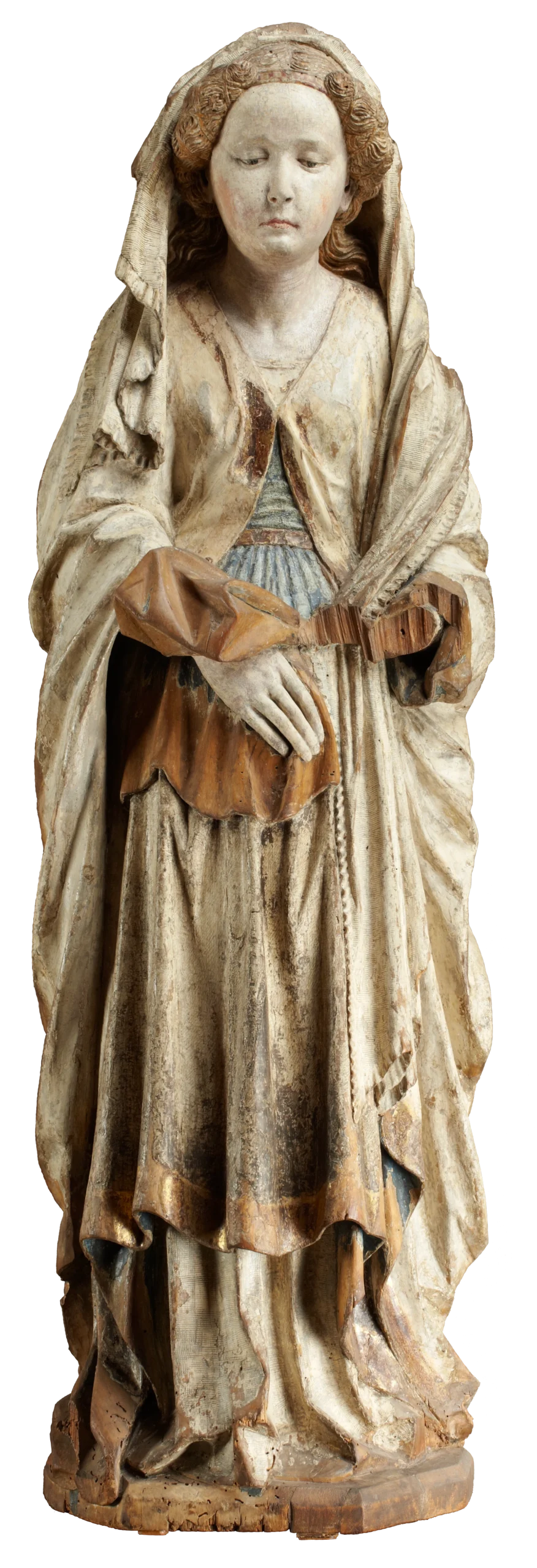
Downcast eyes, slumped shoulders and flushed cheeks: anyone attending church can identify with a Mary Magdalene like this – especially in the face of deep sorrow.
Saintly nude
A naked saint? Scandalous, one might think. Yet from the 15th century onwards, as the human body began to attract renewed interest from artists, such images gained currency.
The human body reclaimed the attention of artists and scholars. The discovery of classical sculptures and texts in the 15th century initiated a cultural shift in Italy. Mary Magdalene was reimagined – clad only in her long hair.
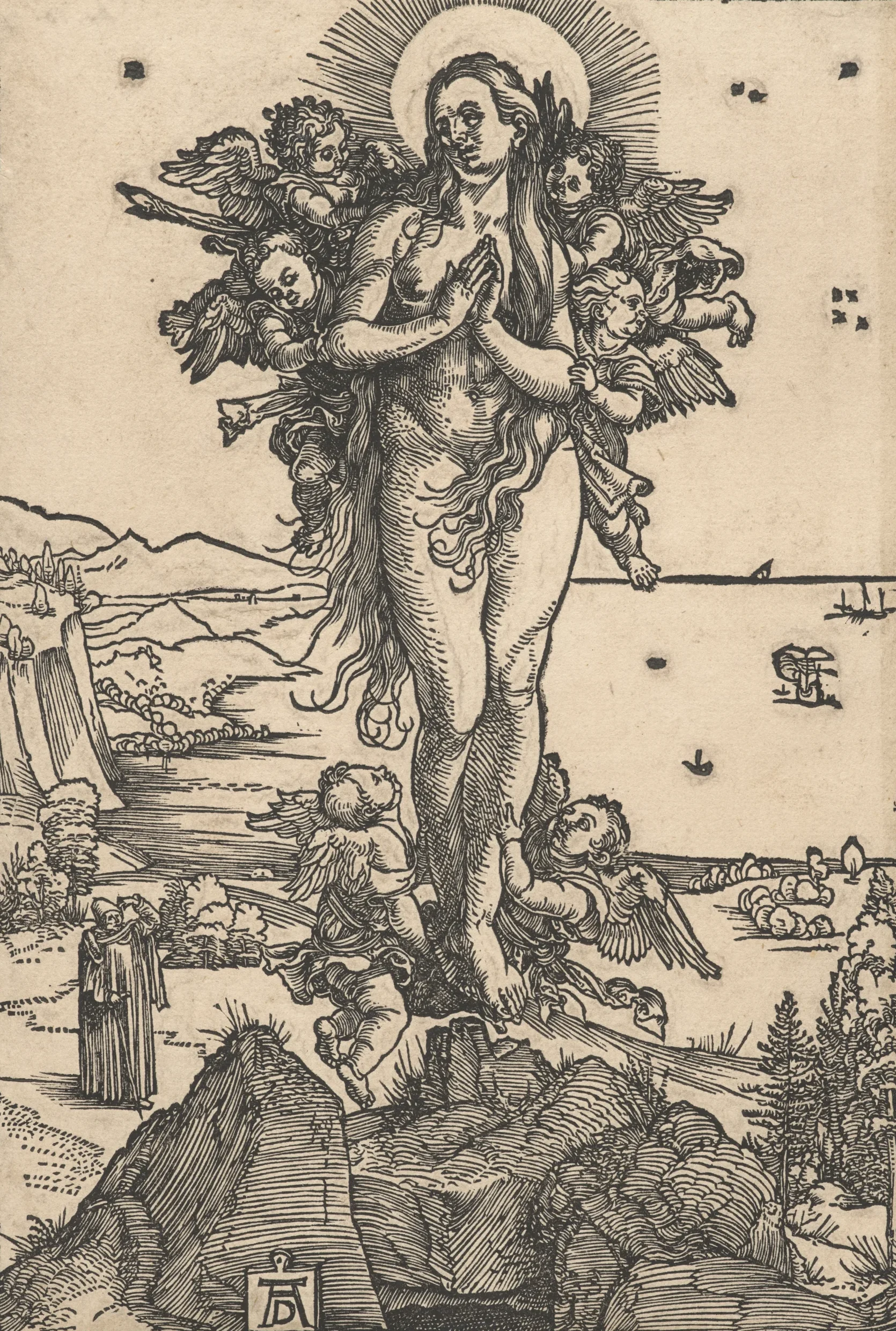
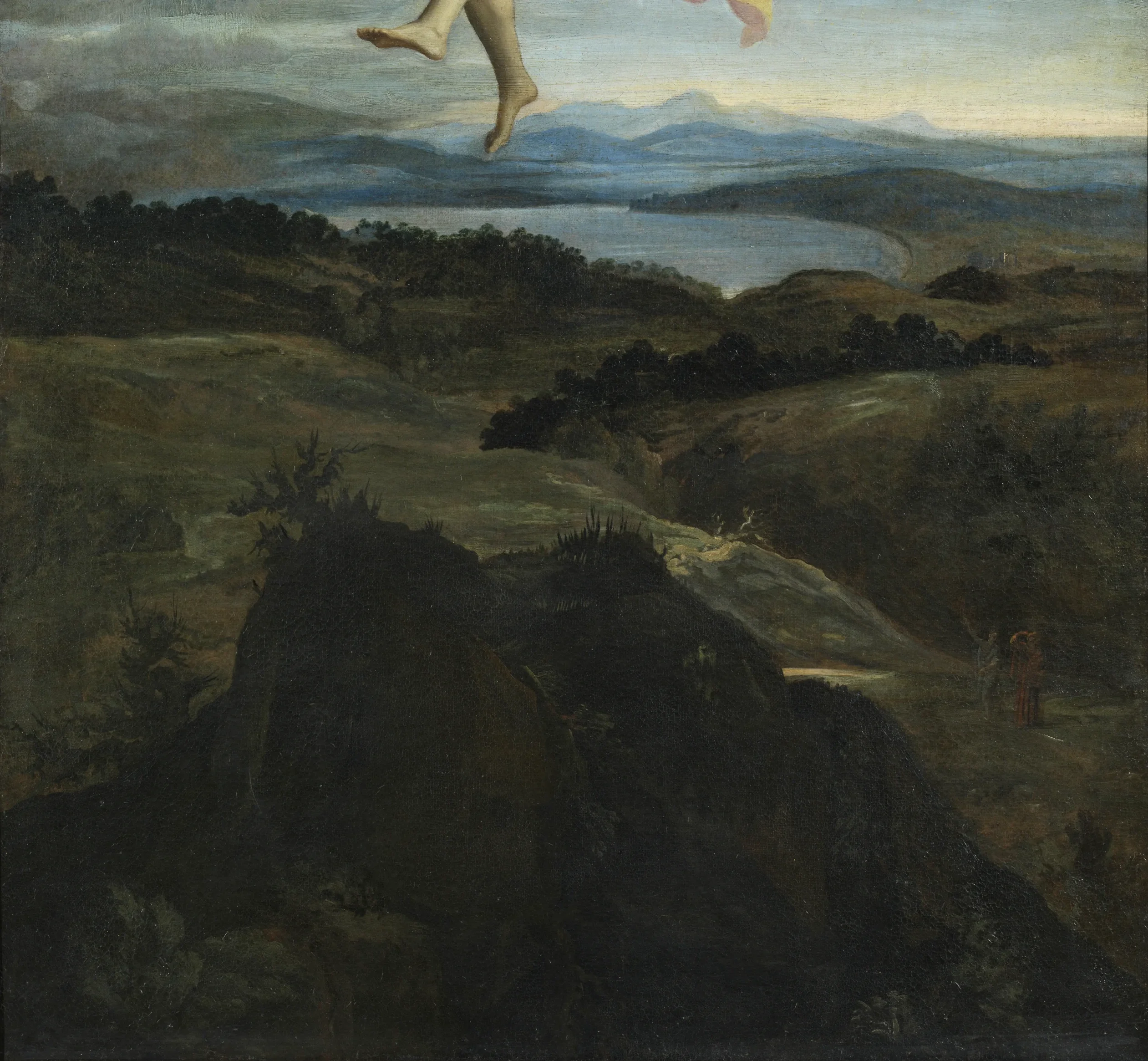
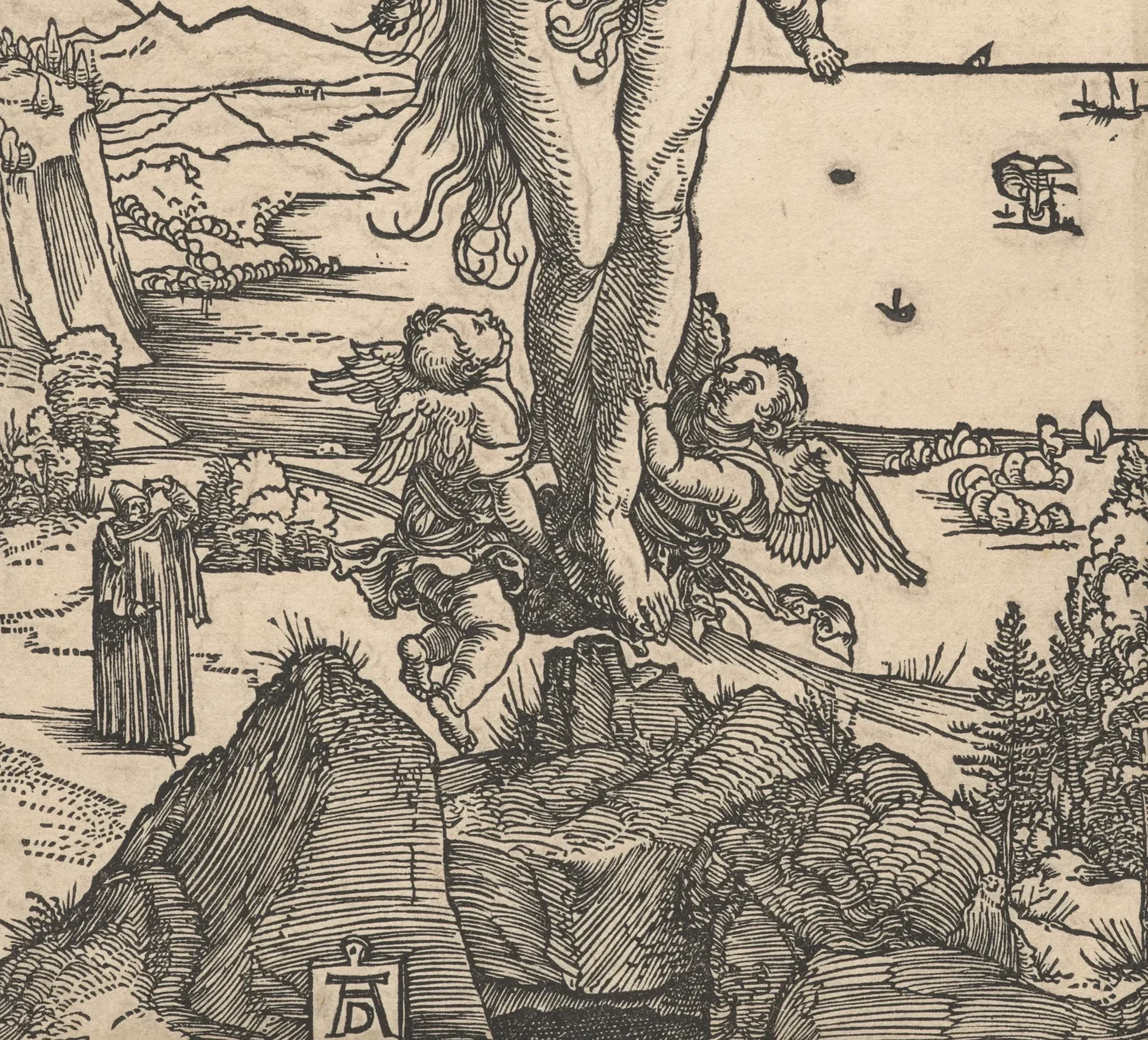
Albrecht Dürer (1471–1528) shows one of the most significant episodes in the legend of Mary Magdalene: angels lifting her up to provide her with heavenly sustenance in the form of song throughout her thirty-year retreat in the wilderness.
Far from leaving the hermit frail and withered, the ascetic life seems to be working wonders on her figure! Her voluptuous appearance is entirely in keeping with the body ideal of the time, which was informed by classical sculptures of Venus, goddess of love.
Under the banner of Humanism
Whereas in the Middle Ages human existence on earth had been primarily seen as a preparation for life eternal in the presence of God, towards the end of the 15th century humanist scholars broke with this notion. Inspired by newly discovered classical sculptures and other antiquities, they began to engage with the art and philosophy of the classical past. The individual – self-determined and self-aware – took centre stage and became the subject of close observation and research. The human body was measured, calculated, drawn, and described.
The humanists remained committed to the Christian faith but sought to reconcile ancient concepts of morality and philosophy with those of Christianity.
The motif enjoyed great popularity – not only within church walls. Dürer catered to public demand by producing it as a woodcut. Inexpensive and produced in large editions, such prints reached a wide audience. About a century later, Giovanni Lanfranco (1582–1647) painted a very different vision of Mary Magdalene borne aloft.
Far removed from ideal beauty and divine perfection: stringy hair, sallow skin, and a belly swollen from hunger and malnutrition convey the hermit’s self-imposed hardships with striking realism.
A rocky plateau in the foreground and the coast of Marseille in the distance – both artists draw on the Provençal legend of Mary Magdalene. A few kilometres further inland lie both the hermit’s grotto in the Sainte-Baume massif and the Basilica of Saint-Maximin-la-Sainte-Baume. In 1279, the Angevin Charles II of Naples, then regent of the Provence, claimed to have found the true sarcophagus of Mary Magdalene in the crypt of the church.
The end of an era
When Pope Boniface VIII confirmed the authenticity of the relics of Saint-Maximin-la-Sainte-Baume sixteen years after their discovery, Vézelay abruptly lost its status as a major pilgrimage destination. From then on, the “true” remains were in the hands of the Dominicans, who were entrusted with establishing a new holy site in Provence.
Encounter in the garden
Art expands its vision: no longer is it just the body, but nature itself that takes center stage. In a verdant landscape, Mary Magdalene desperately seeks the body of Jesus and is suddenly confronted with the risen Christ. He stands before her in the flesh – a moving encounter that has inspired artists for centuries.
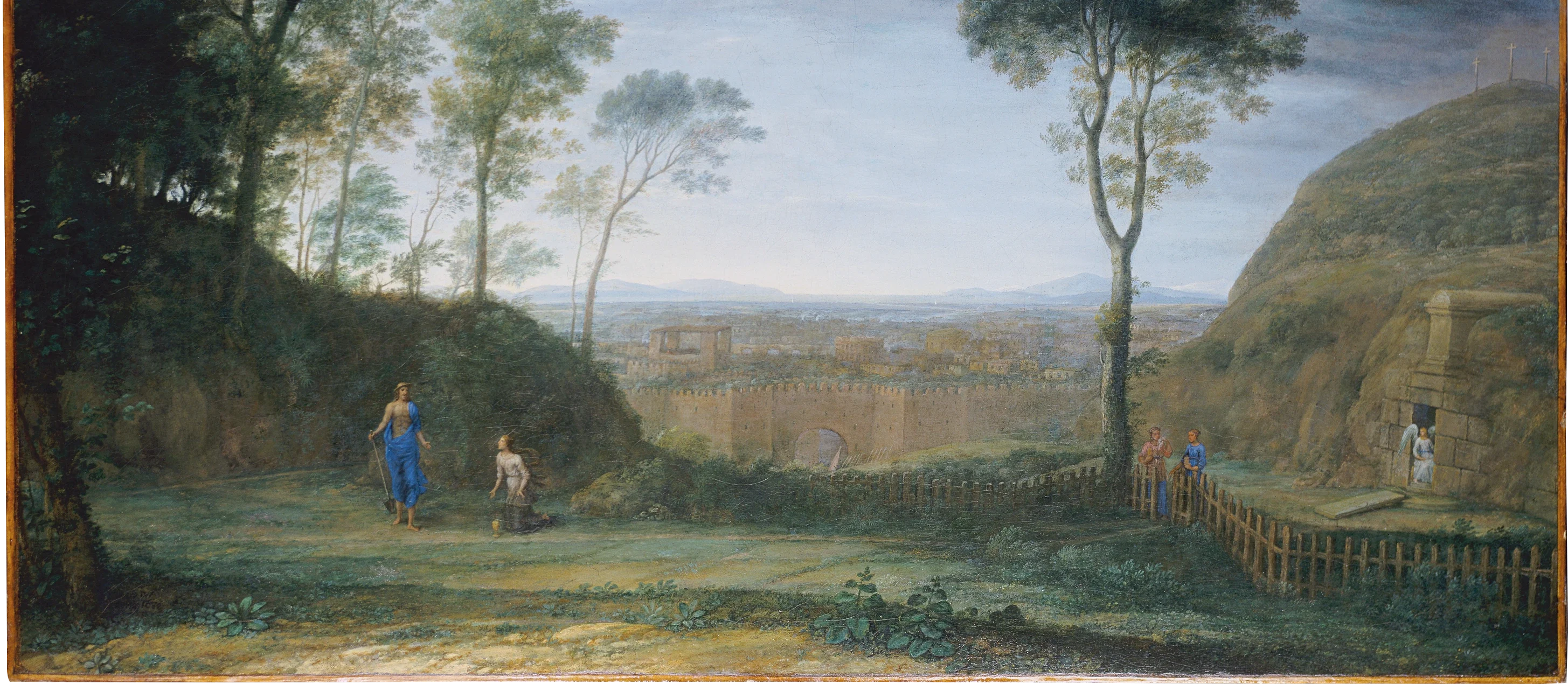
The painting by Claude Lorrain (1600/05–1682) is a landscape painter’s take on the biblical subject. The empty rock-hewn tomb, guarded by an angel, is set in a light-suffused open landscape, far from the city walls, at the foot of a hill, identified as Golgotha by three pale crosses on its summit.
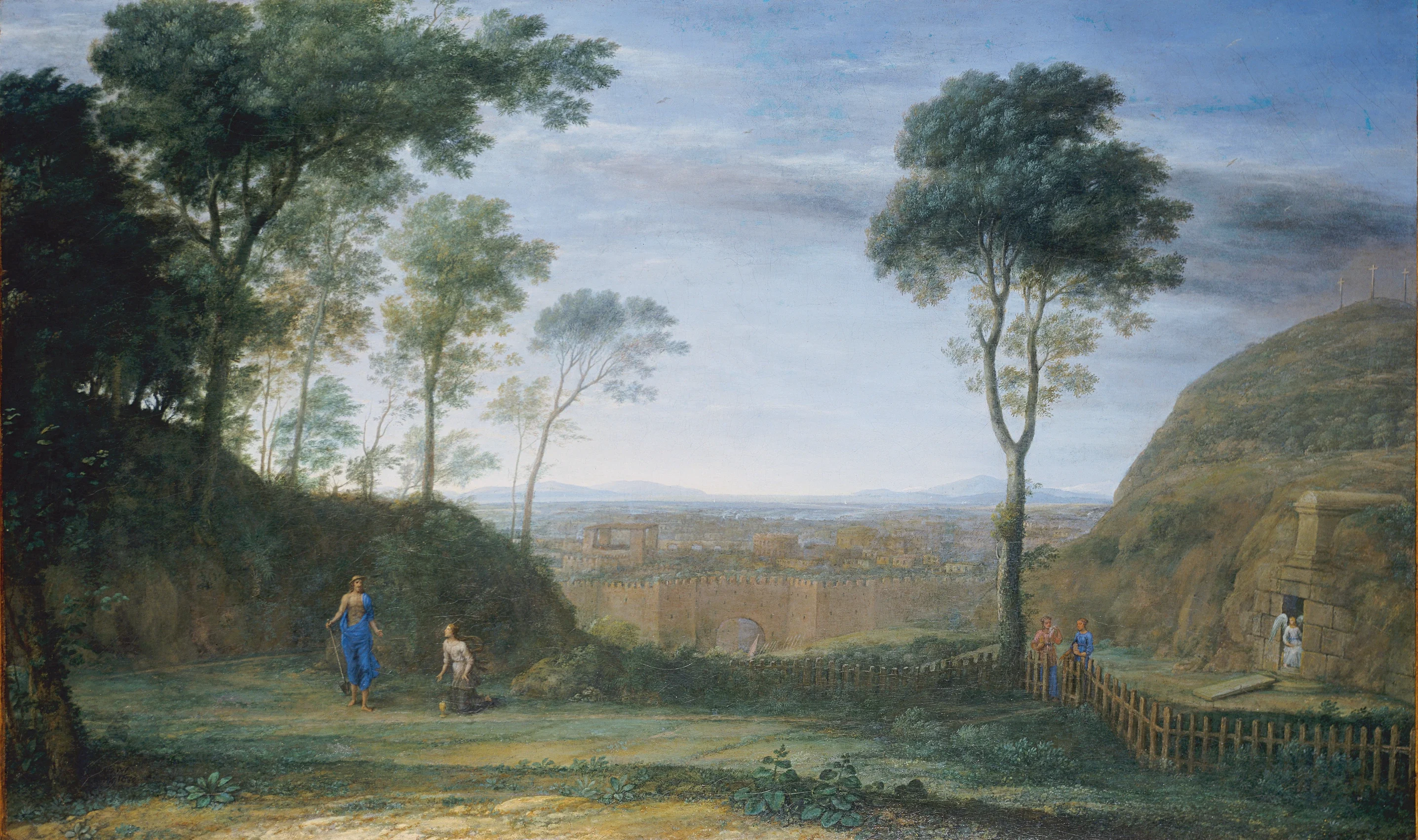
Mary Magdalene was the first to encounter the risen Christ. The painting, commissioned by the Roman Cardinal Fabrizio Spada (1643–1717), shows this significant moment visualised on the left-hand side of the canvas.
Spada’s hidden message
Across much of 16th-century Europe, the reformist ideas of theologians such as Martin Luther (1483–1546) and John Calvin (1509–1564) led people to embrace a new faith. The reformers contested the authority of the “Roman Catholic Church” as the ultimate source of spiritual truth and questioned the sacrament of penance and the veneration of saints.
Cardinal Fabrizio Spada, on the other hand, reconverted Calvinists to Catholicism. It is therefore not surprising that he commissioned a painting of Mary Magdalene, who, legend has it, was the first evangelist of France.
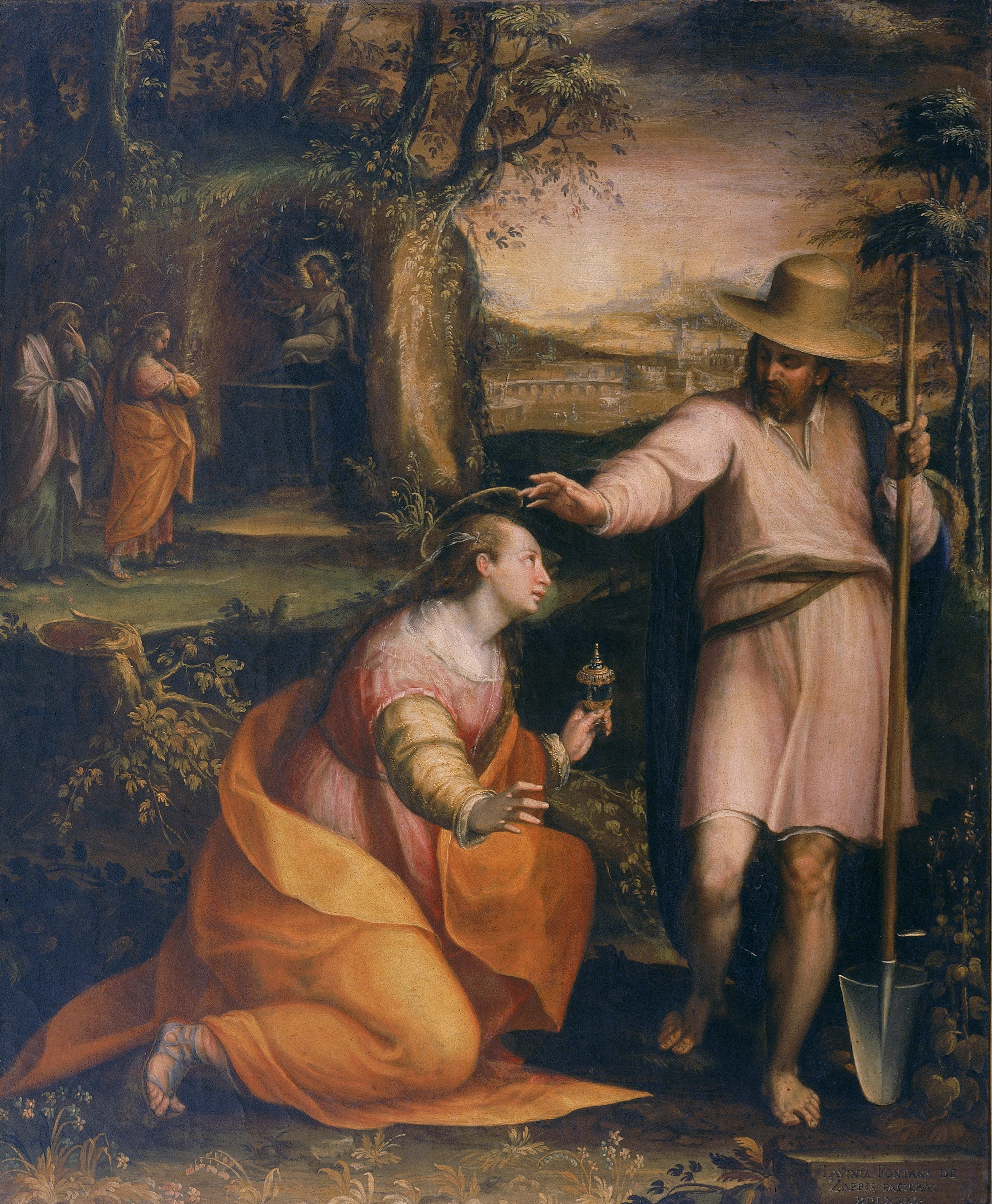
Jesus in a wide-brimmed hat, holding a spade? The motif is not as eccentric as it may first seem and in fact features in countless paintings besides this one. The Gospel of John recounts how Mary Magdalene didn’t immediately recognise the risen Christ, instead mistaking him for a gardener.
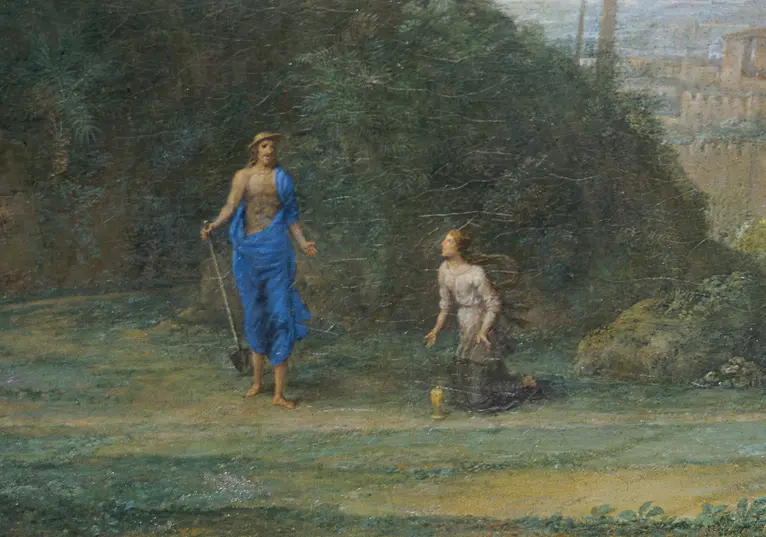
“She, supposing him to be the gardener, saith unto him, Sir, if thou have borne him hence, tell me where thou hast laid him.”
John 20:15
A century before Claude Lorrain, this passage also inspired the Italian artist Lavinia Fontana (1552–1614). Mary Magdalene, wrapped in a striking yellow cloak, dominates the centre of her painting, while the preceding scene of the three Marys finding the angel sitting at the entrance to the empty tomb is shown in the background.
Iconic images
A saint – more human and relatable than ever: free from any episodic narrative, intimate individual portraits bring Mary Magdalene into focus. Even today, celebrities present themselves in the role of the saint.
An icon set against a celestial blue background – it is only details such as the glistening silver tears, long hair and, of course, the overt nudity that suggest who we’re looking at here is Mary Magdalene.

The combination of sensually charged aesthetics and religious symbolism recalls the iconography of the Magdalene’s transformation from sinner to penitent. In the role of Mary Magdalene, the artist David LaChapelle (b. 1963) casts Kim Kardashian (b. 1980), one of the most influential – and most polarising – female celebrities of 21st-century American pop culture. Using her body and self-empowered femininity with great success and confidence, she too has achieved a cult status of her own.
“Celebrity is replacing religion in these times of turmoil.”
David LaChapelle
Since the late 15th century, numerous influential figures have chosen to be portrayed in the role of Mary Magdalene. Each of these works attests to the enduring fascination of this multifaceted saint.

Symbol of power
With a jar of ointment in her hands and long wavy hair streaming out from beneath her headdress, this figure would have you believe she is Mary Magdalene. But the woman in the elegant gown set against a rolling landscape is in fact Margaret of Austria (1480–1530) and would have been recognised as such by those familiar with her. The daughter of Emperor Maximilian I and Mary of Burgundy was made governor of the Burgundian Netherlands in 1507.
This portrait historié by Margaret’s court painter Barent van Orley (1487–1541) is a political statement. As the rightful heir to the Duchy of Burgundy – which had since been annexed by the King of France – she consistently emphasised that the land actually belonged to her family, the Habsburgs.
The display of spiritual kinship with the saint serves as a reminder of her strong ties to Burgundy. After all, the princely couple of Marseille, who had been converted to Christianity by Mary Magdalene and blessed with an heir to the throne, were posthumously bestowed the title of ‘King and Queen of Burgundy’ in the 15th century. This was undoubtedly influenced by the fact that the Abbey of Vézelay, the first significant site of her veneration, was likewise situated in Burgundy.
Face to face with the viewer. The first half of the 16th century sees the emergence of images that put Mary Magdalene centre stage. In the absence of narrative content, they rely solely on symbols such as the ointment jar, skull, or loosely falling long blonde hair to allude to the saint’s identity. The overt display of her physicality, beauty, and sensuality may strike many a modern viewer as erotic.
At our fingertips
Looking for a new sense of connection: the figure of Mary Magdalene is pushed so close to the picture plane and the viewer’s space that the boundary between image and reality becomes blurred.
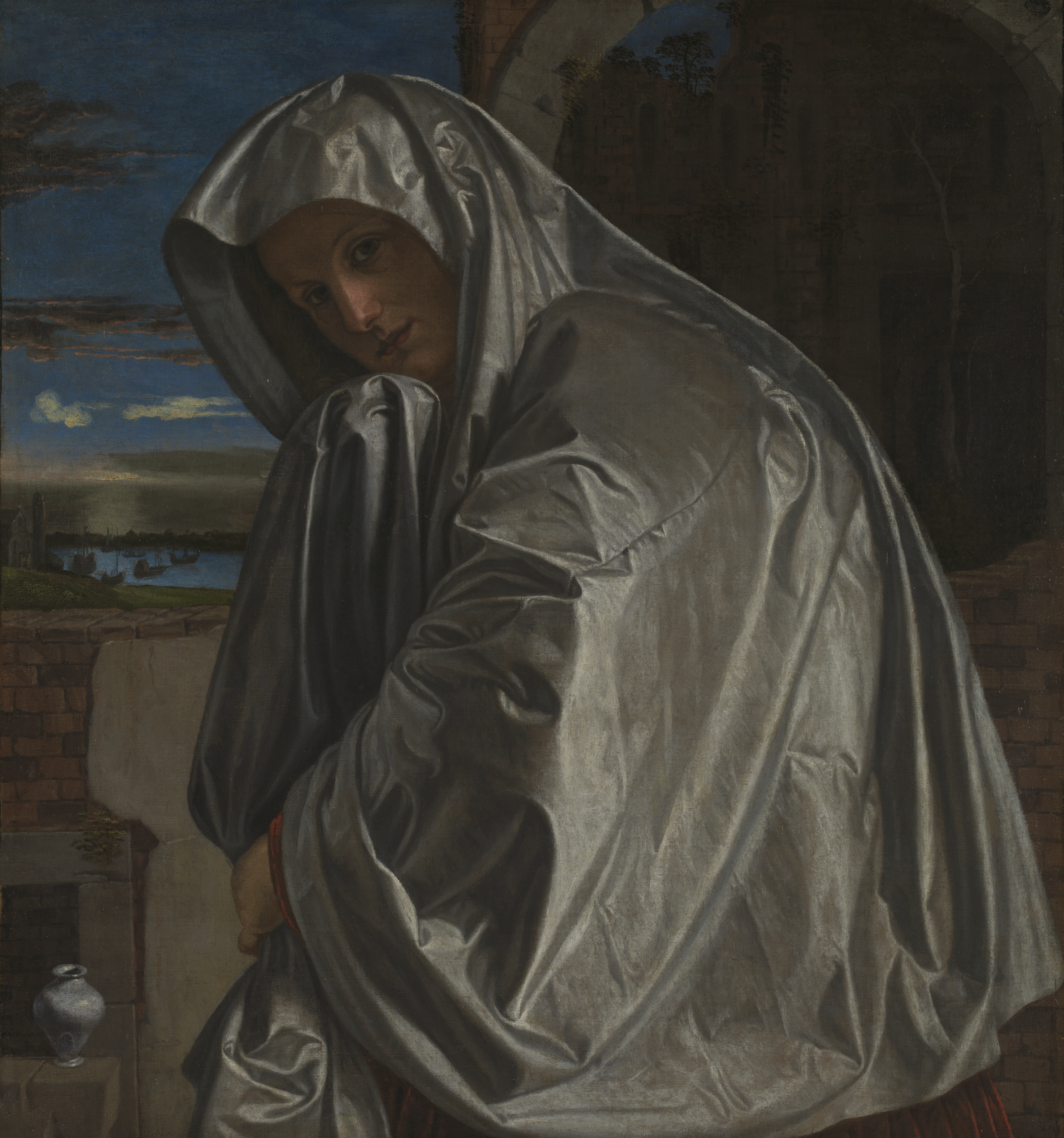
It is one of the earliest and, at the same time, most memorable portraits of the saint: no Mary Magdalene before her had turned to face the viewer with quite as much intentionality.
The Venetian painter Giovanni Girolamo Savoldo (c. 1480–c. 1549) has Mary Magdalene looking at the beholder from beneath a shimmering silk shawl, her pensive face propped up on her right hand. The only narrative detail is the subtle hint of the rising sun. It evokes the Easter morning, when Mary Magdalene found Christ’s empty tomb.
Mary Magdalene seems close enough to touch: is Savoldo responding to a longing for the physical presence of the saints?
This need for physical closeness also recalls the saint’s face-to-face encounter with the risen Christ. A subject that Laurent de La Hyre (1606–1656) translated into a striking painting.
Mary Magdalene wants to touch Christ – but he gently draws back: she must not touch him, let alone hold on to him, the Gospel of John tells us. Artists such as La Hyre, however, expanded on this moment and showed Christ, in a controlled gesture, placing his hand lightly on her forehead.
The power of touch
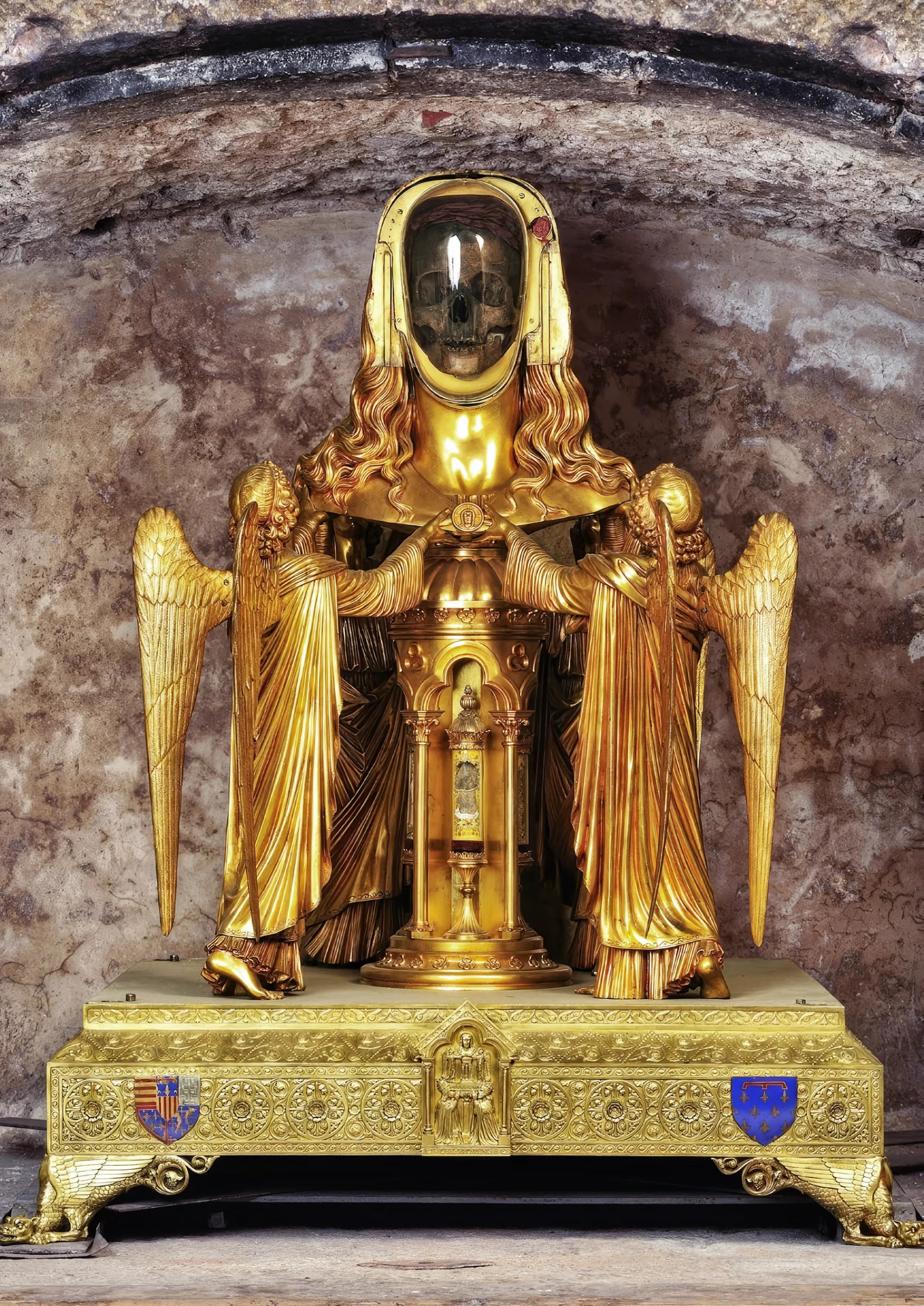
Christ’s direct touch of Mary Magdalene’s forehead – a most unusual gesture for two figures traditionally associated with the statement Noli me tangere or “Touch me not”. The motif may have been inspired by the skull relic of Mary Magdalene, which continues to be venerated in the Basilica of Saint-Maximin-la-Sainte-Baume. Legend has it that, when it was found, the skull still had a patch of intact skin on the forehead – exactly where keepers of the relic claimed the risen Christ had touched her.
Penance and ecstasy
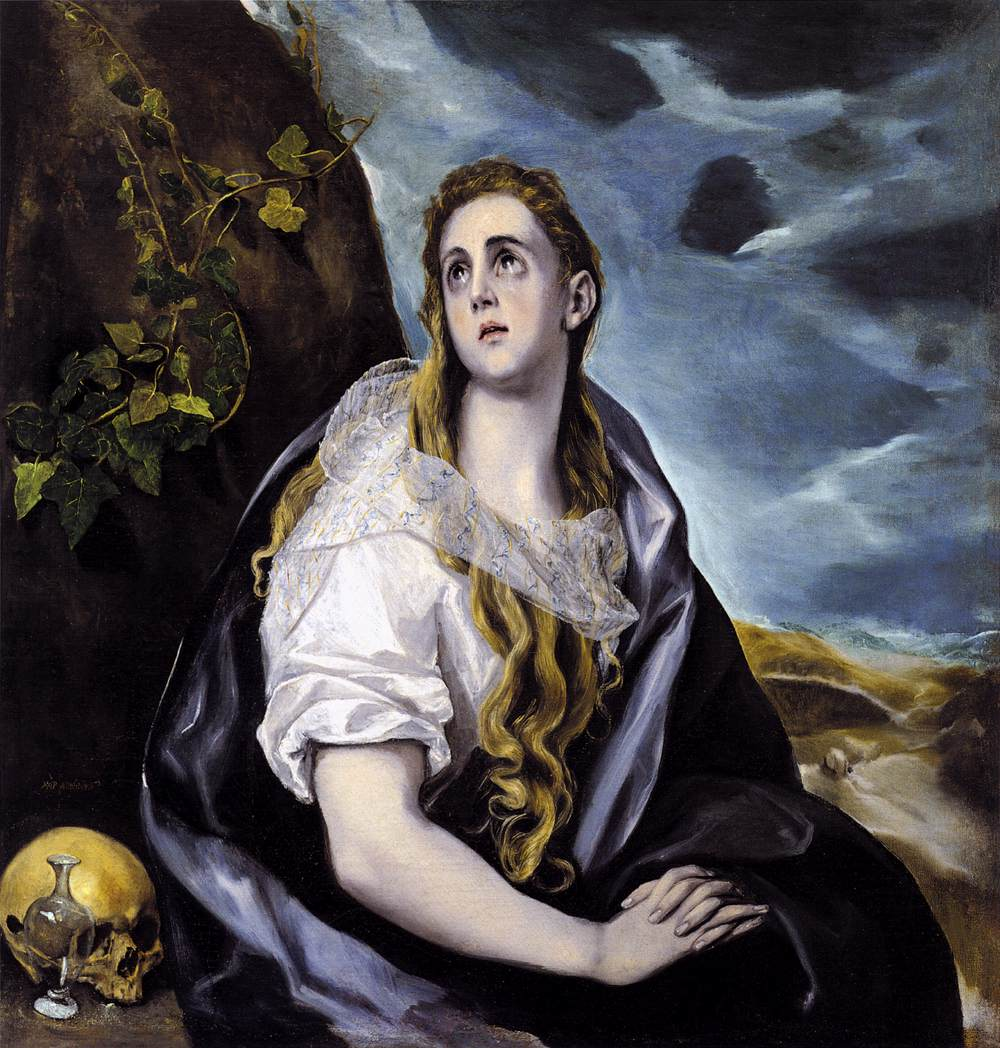
At a time when Protestant reformers were rejecting the veneration of saints and images, the Catholic Church responded by humanising sacred figures and privileging direct personal engagement. The penitent, grieving Mary Magdalene is portrayed as an emotional, profoundly human figure, intended to move the faithful and to stir feelings of sorrow and compassion.
With flushed cheeks, tears streaming down her face and eyes looking heavenward in rapt devotion, Titian’s (1488/90–1576) moving painting of Mary Magdalene is designed to stir compassion. Exquisitely rendered details, such as the glass ointment jar and the skull, allude to her witnessing the crucifixion and, at the same time, serve as a reminder of the transience of life.
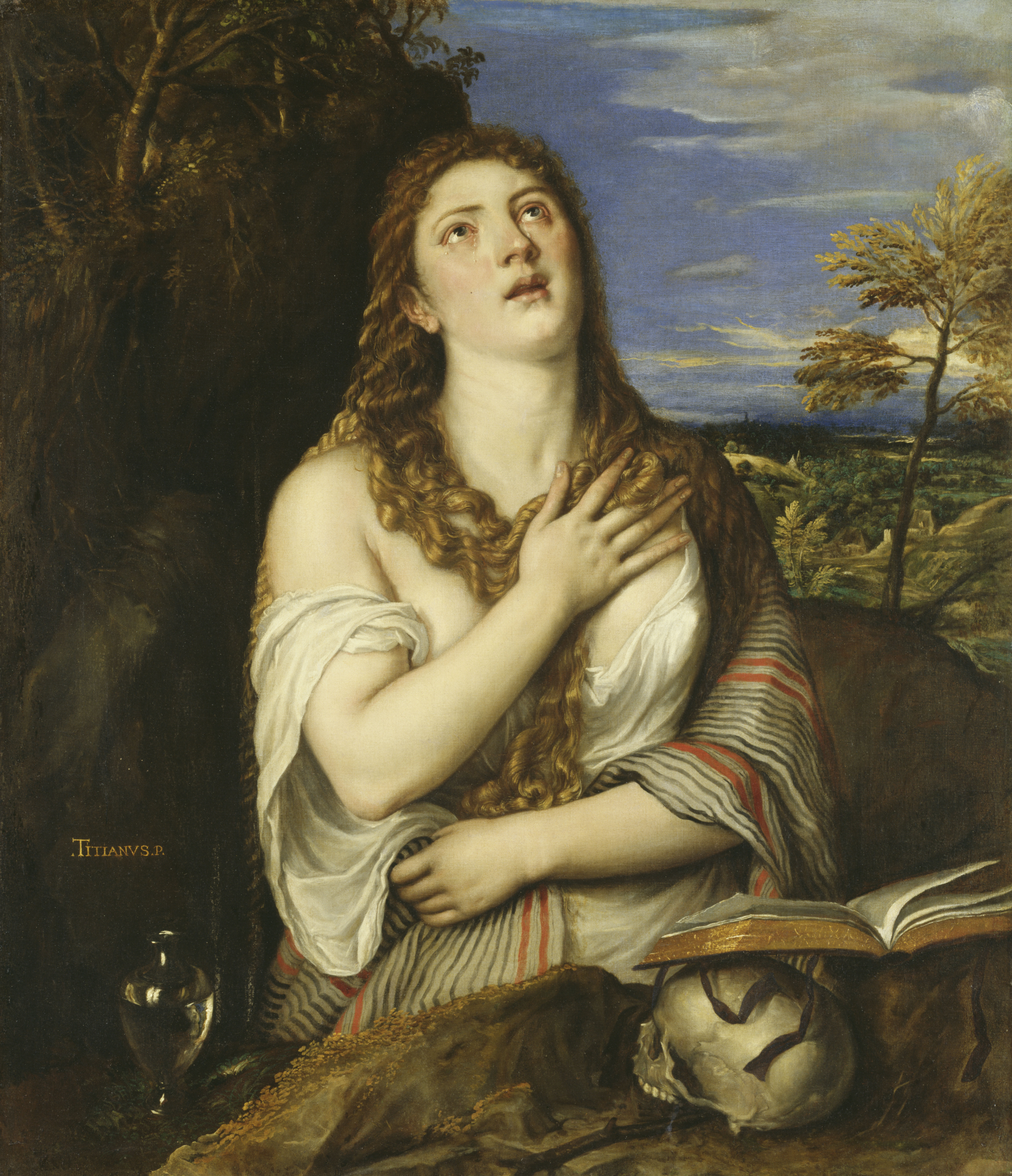
Titian’s workshop produced no fewer than around 25 paintings of Mary Magdalene. This version was painted after the Catholic Church, in the wake of the Council of Trent, imposed rules to regulate artistic production: art was to instruct and promote piety and moral rectitude. Moreover, the representation of saints was to avoid excessive nudity and eroticism.
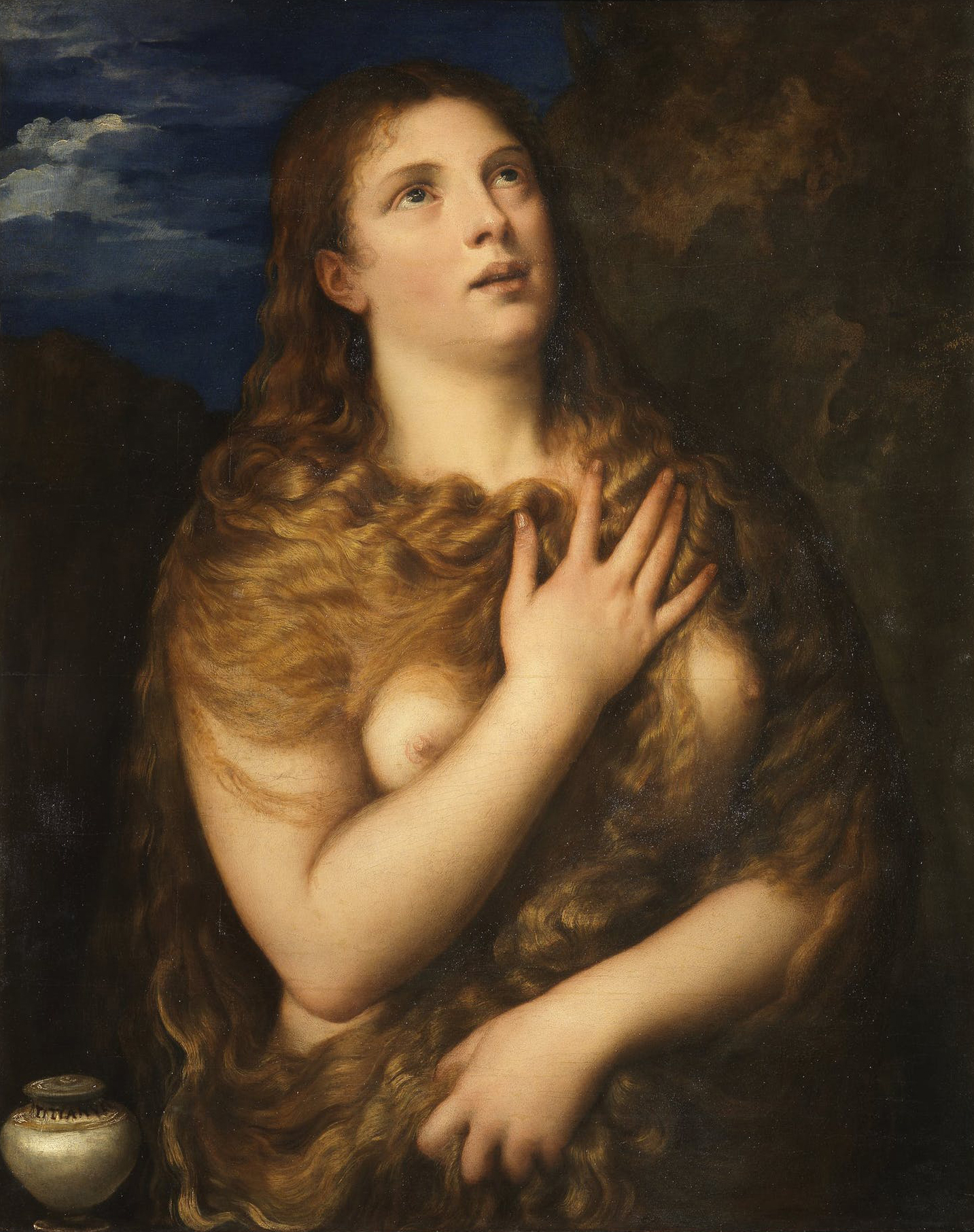
Here Titian complies with the rules and covers the breasts of his Magdalenes. But in an earlier version the artist had shown the penitent completely naked, the fleshiness of her body accentuated by her long tresses.
Painted around a century after Titian’s work from the 1530s, Francesco Furini’s (1603–1646) Mary Magdalene comes across as similarly soulful and approachable. The Florentine painter and priest cannot quite resist investing her with a modicum of sensuality.
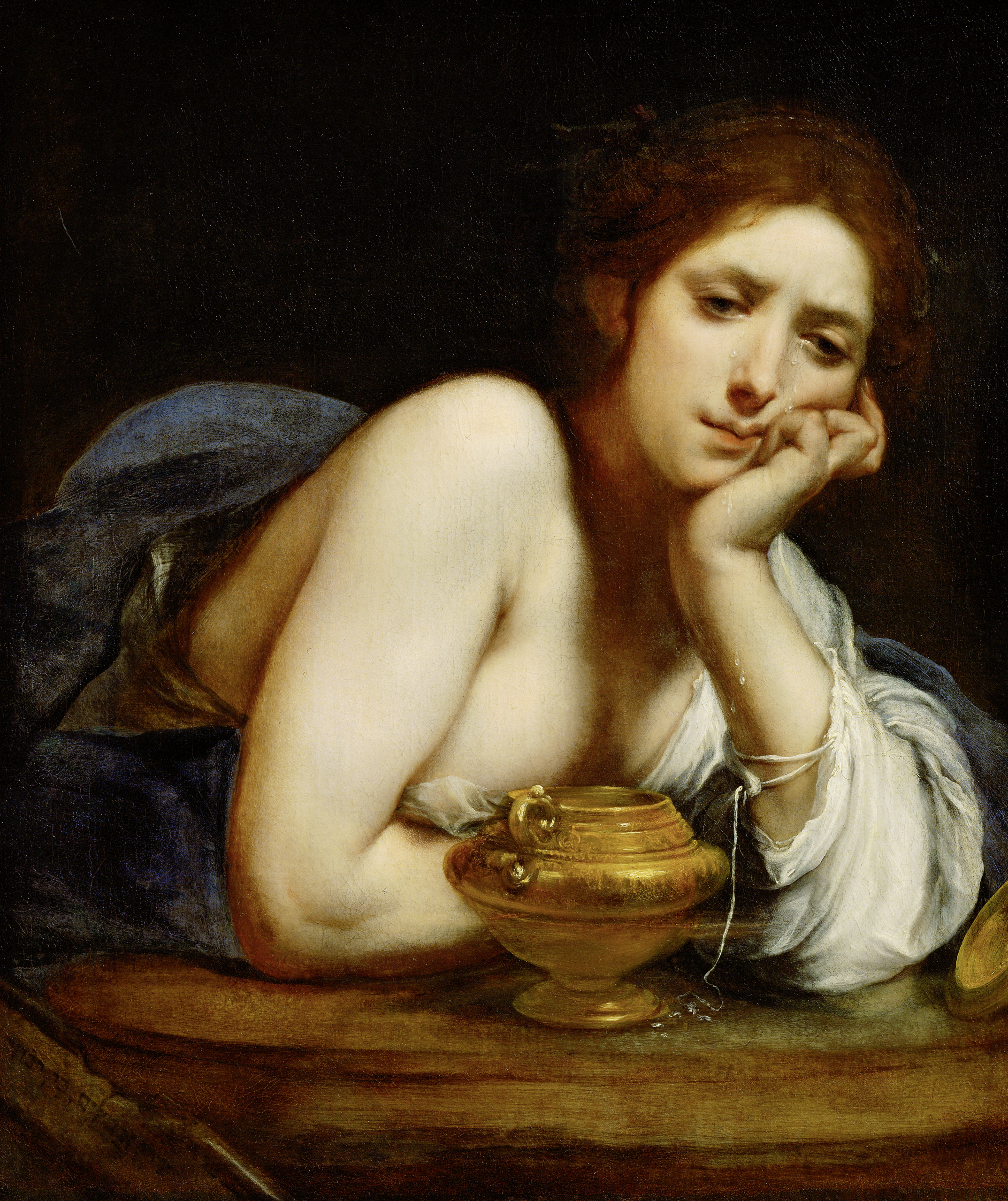
Tears
Puffy-eyed and tear-stained, the penitent is consumed by profound grief.
Ointment jar
The ointment jar recalls the former sinner who anointed Christ’s feet – but also Mary Magdalene’s visit to the tomb. The painting shows her lost in melancholic contemplation.
Sensuality
The scrap of transparent material is barely enough to cover her breast; the dishevelled undergarment alludes to the sinner.
The sinner under scrutiny
It was not until 1969 that Pope Paul VI officially revoked the conflating identification of Mary Magdalene with Mary of Bethany and the unnamed “sinful woman”. However, calls to this effect had been made much earlier. As early as 1517, the Catholic theologian Jacobus Faber Stapulensis (1450/55–1536), provoked heated debate when he argued that the three women were distinct individuals. There was great concern that the foundational narrative of the momentous transformation from sinner to penitent would lose its meaning if the composite Mary Magdalene were to be stripped of her past as a sinner. As the sacrament of confession and penance is central to Catholicism, the deconstructed saint would have deprived the Church of its most popular model penitent.
Confession is still one of the seven sacraments of the Catholic Church that can be administered by a priest. In the name of Christ, he can absolve the repentant of their sins.
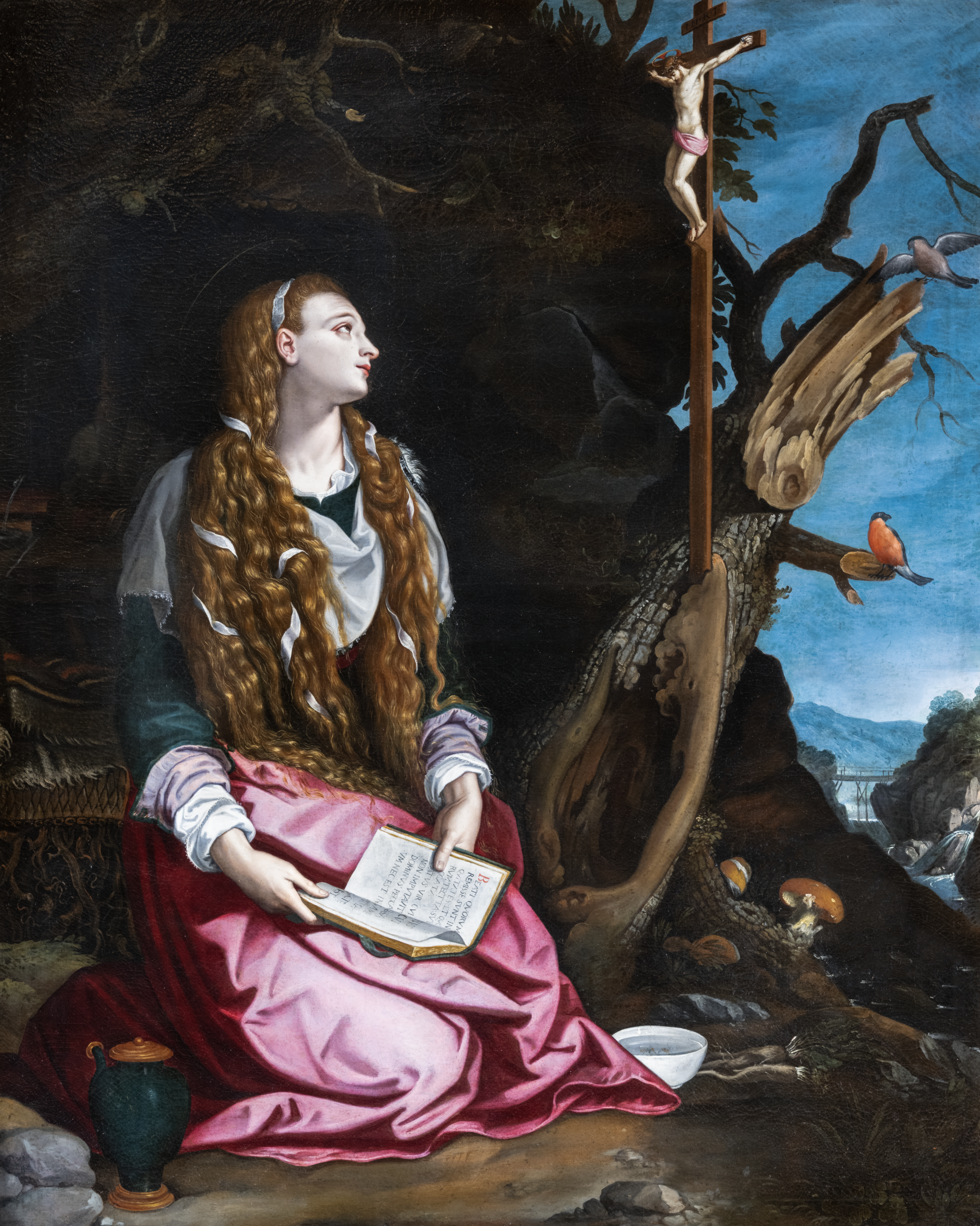
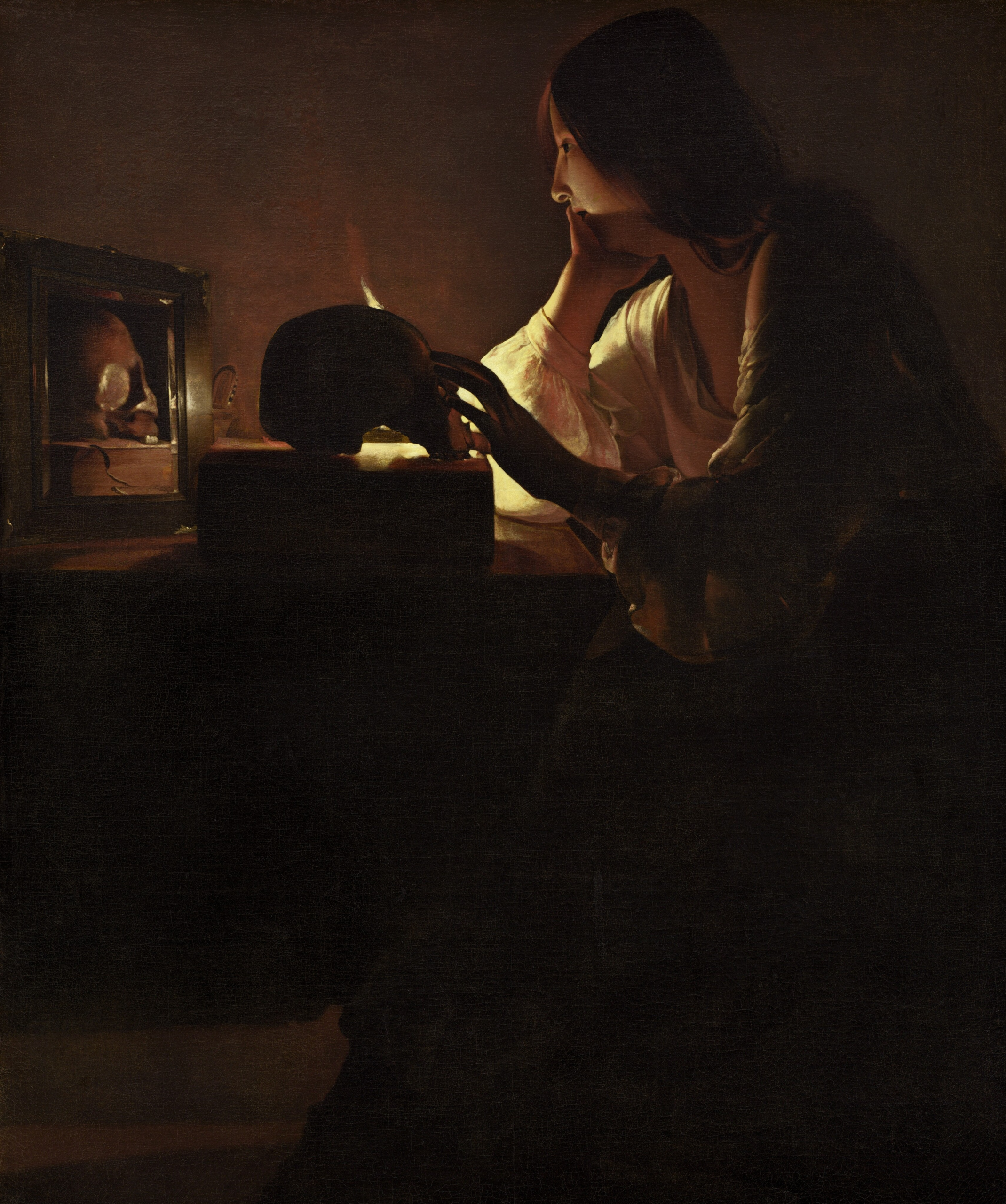
The number of works showing Mary Magdalene as a recluse in the wilderness is beyond count. The motif of the converted sinner doing penance enjoyed great popularity, particularly in the late 16th and early 17th century. In the wake of the Counter-Reformation (the Catholic response to the Reformation) the sacrament of penance, and, with it, images of the penitent woman, assumed renewed significance within the Catholic Church.
This painting is a provocation! While Guido Cagnacci (1601–1663) employs the visual components associated with the iconography of Mary Magdalene, their combination produces a scandalously erotic effect.
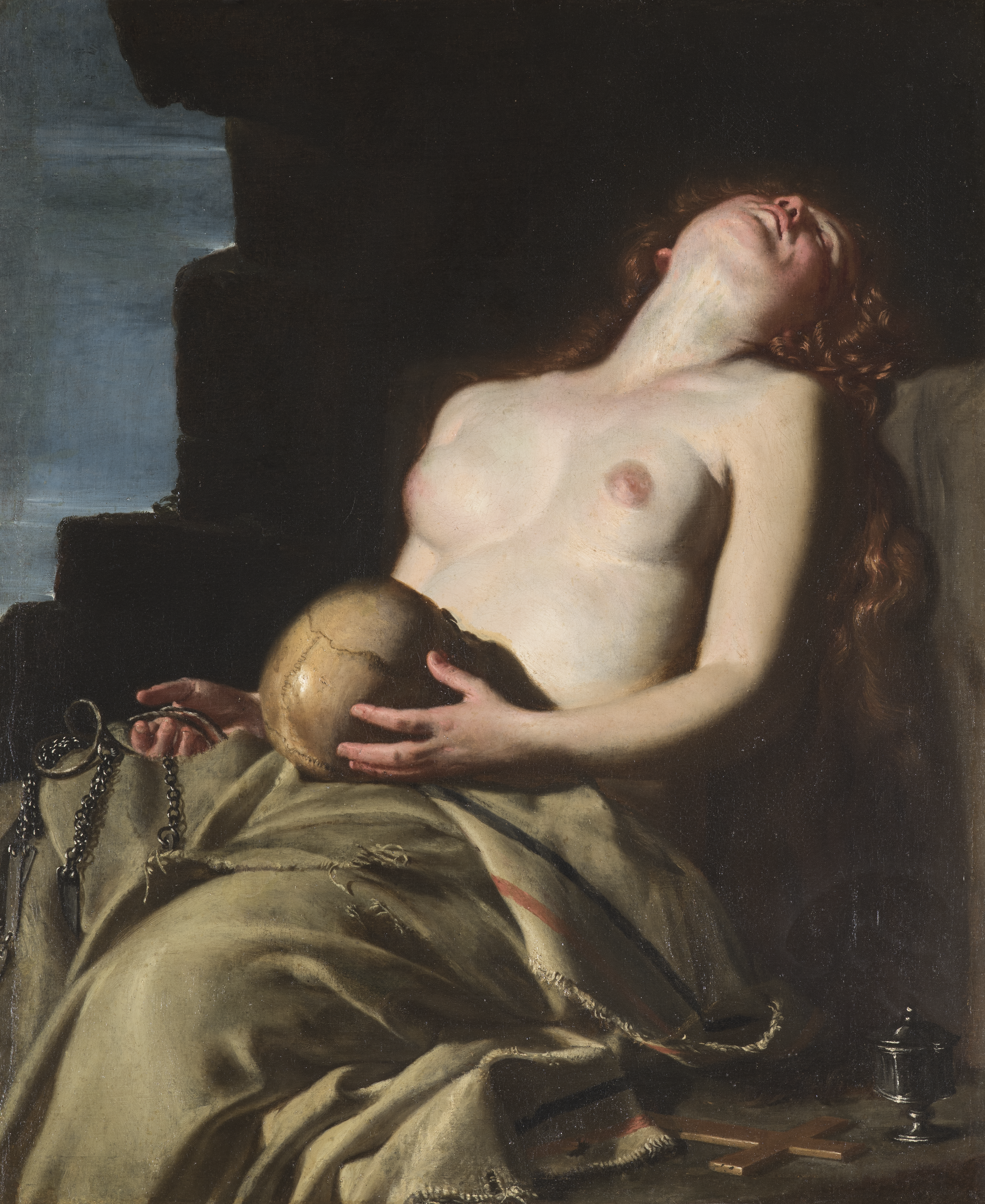
Blatant nudity
Dramatically lit: the painter offers the beholder a view of the saint’s reclining, bare upper body.
An invitation to look?
It is no doubt with provocative intent that the painter has chosen to place the skull, symbol of penitence, reflection, and mortality, in Mary Magdalene’s lap, its empty eye-sockets pointed towards her bare breasts. An invitation to a peepshow; celebration of the male gaze? Or a reminder of our own susceptibility to temptation?
Instrument of mortification
The painter contrasts sensual eroticism with the most radical, most painful form of penance: Mary Magdalene holds an iron scourge in her hand. Thus, her pose and her closed eyes can be interpreted as exhaustion following mortification in the form of self-flagellation – or as orgasmic ecstasy.
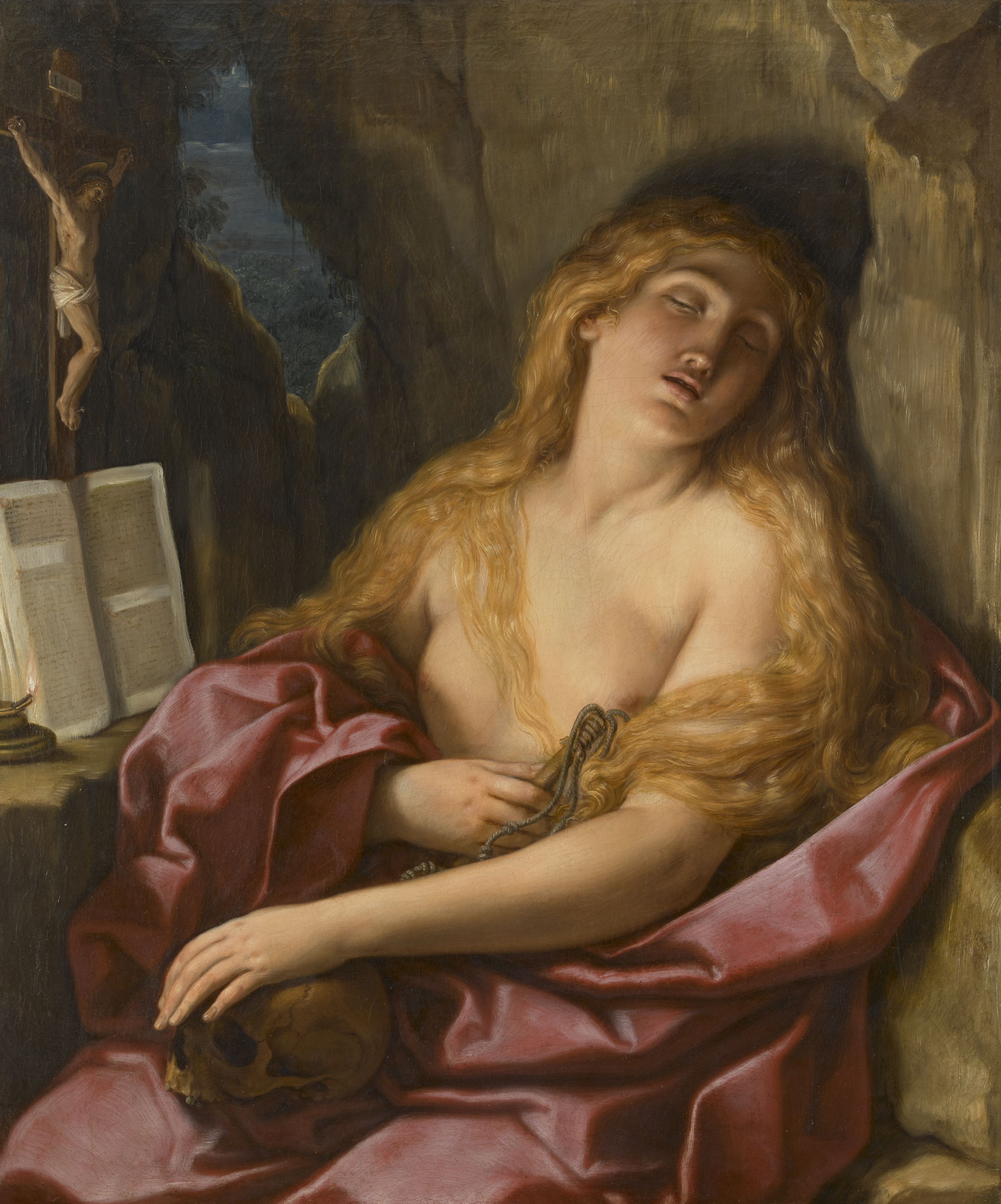
Today, the depiction with closed eyes, head tilted back, and exposed upper body appears highly erotic. In the 17th century, however, this physical abandon visualizes the experience of religious ecstasy: from the perspective of the Catholic Church, it is precisely this state that expresses the mystical encounter between God and humanity—which served, not least, to clearly distinguish itself from Protestantism, with its primary focus on the sober interpretation of biblical scripture.
Despite formal similarities, the eroticism of Elisabetta Sirani’s ecstatic Mary Magdalene is noticeably more subdued – particularly when compared with the painting by her male colleague. Sirani’s Penitent Magdalene is less provocative, less sexualised. Her body appears not so much taut with orgasmic ecstasy as slumped in exhaustion.
Modern accounts
Mary Magdalene has lost none of her appeal – even at a time when society arguably attaches less importance to religion, and less still to penance and self-restraint. In 19th- and 20th-century art, her image, always multifaceted, offered a way of raising and exploring modern questions and identities.
What might a modern Mary Magdalene look like? Pierre Puvis de Chavannes (1824–1898) chooses not to dramatise or idealise her. In the tranquillity of her solitary retreat, his hermit is completely at one with herself.
While the saint is often portrayed in meditation, it is unusual to find her engaging in the practice standing upright. However, the French artist leaves no doubt as to her identity: the penitent Magdalene, skull in hand, and knee-length blonde hair flowing down her back, is set against a vast mountain landscape. Puvis de Chavannes renders the limestone massif around Sainte-Baume, dotted here and there with green trees, with rare topographical accuracy.
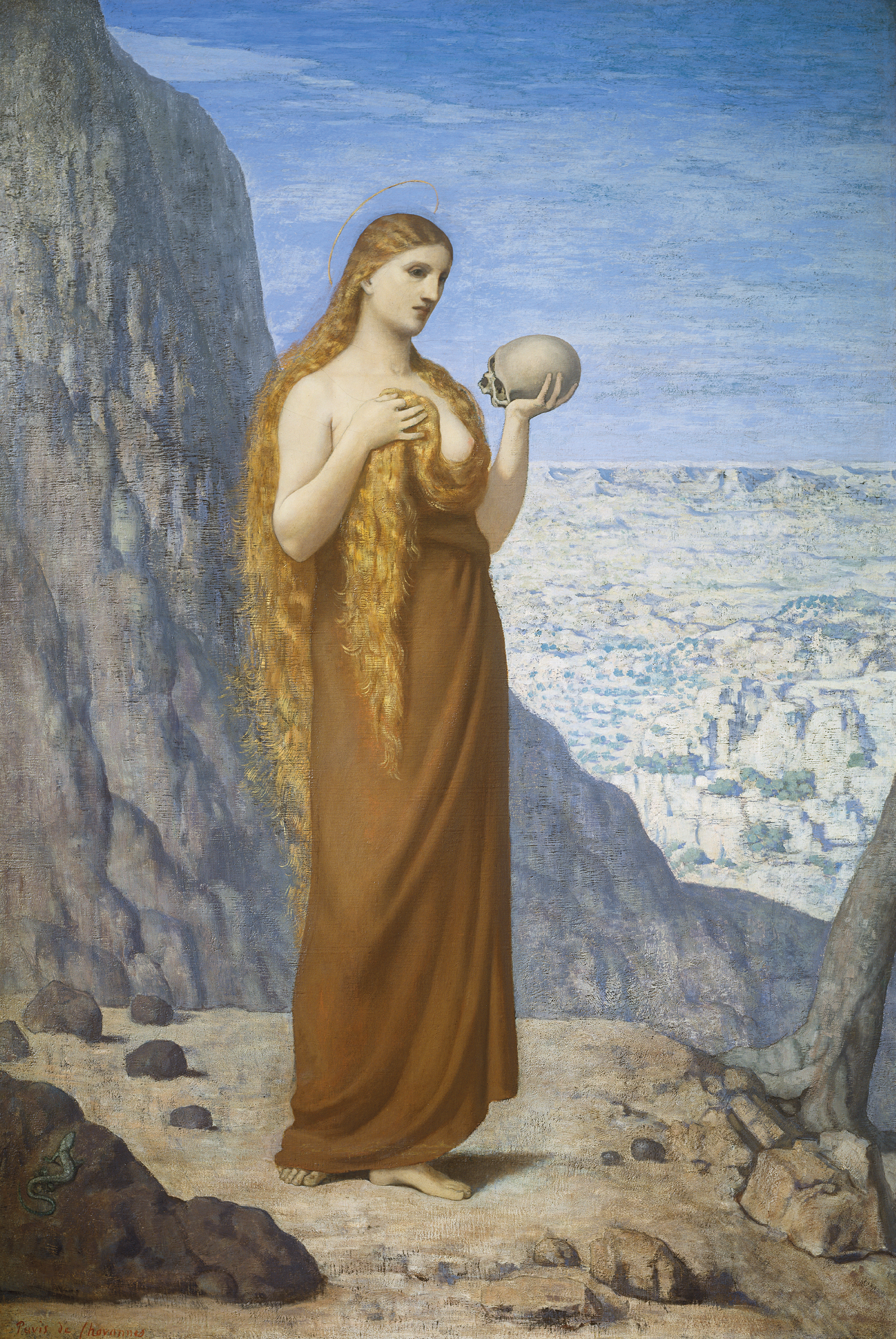
Mary Magdalene’s significance showed no sign of fading – even after the French Revolution, when a clearer separation of church and state takes effect. In the effort to mitigate the effects of this secularization and renew the Catholic faith, the saint serves as a key figure: thanks to her legendary conversion of the princely couple of Marseille, she was and is regarded as the mother of Christian France. And her role again inspired artists, at a time when France was the centre of the art world.
Mary Magdalene at the Paris Salon
France’s most important exhibition: In the 19th century, participating in the Paris Salon – the Academy’s annual exhibition – could decide an artist’s career. No other saint featured in as many paintings shown at the Salon as Mary Magdalene – which speaks to her enduring appeal.
In 1870, Pierre Puvis de Chavannes submitted his Mary Magdalene in the Desert to the Paris Salon. The painting caused a stir: likely because it was ahead of its time, conservative critics disparaged it as a caricature. Nevertheless, the work achieved major success and earned the artist recognition among modern art collectors.
Jean Béraud (1848–1935) offers an artistic – and decidedly critical – commentary on a society divided by questions of faith. The painter stages the Feast in the House of Simon the Pharisee – at which, according to the Gospel of Luke, the sinner appeared before Jesus – as a contemporary bourgeois dinner party. Gathered around Simon’s table are representatives of France’s political, scientific, and artistic elite, who observe the events with barely concealed indifference.
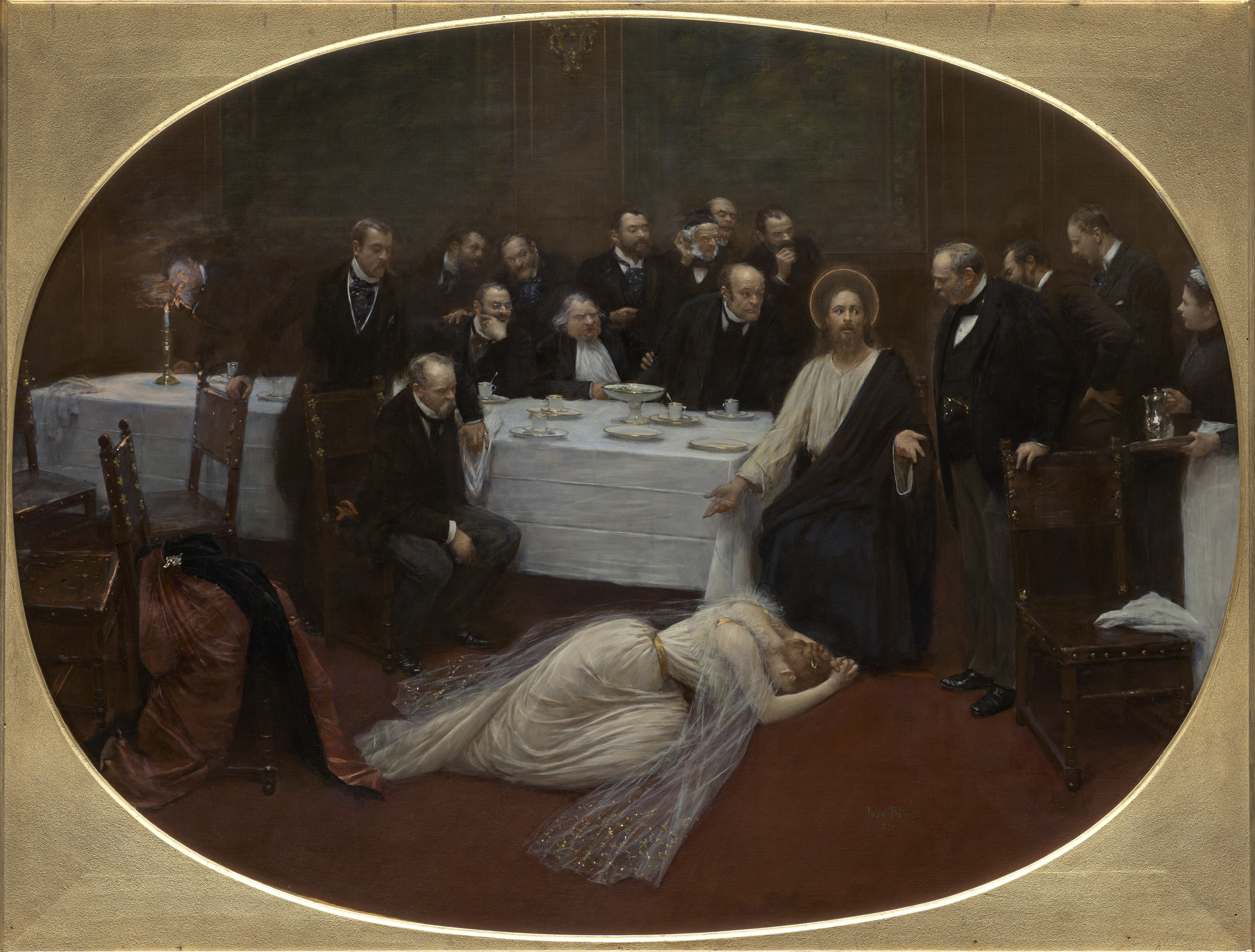
Ernest Renan
Contemporary audiences would have recognised that the figure of Simon the Pharisee is modelled on the historian and writer Ernest Renan (1823–1892). In 1863, his study Vie de Jésus suggested that Mary Magdalene had merely imagined the Resurrection.
Liane de Pougy
Contemporaries would also have recognised the sinner, prostrating herself theatrically on the floor, was none other than the notorious cabaret dancer and courtesan, Liane de Pougy (1869–1950). When the painting was exhibited at the Paris Salon in 1891, it caused a scandal.
Albert Duc-Quercy
A first in art: an identifiable real person is depicted in the guise of Christ. The staunch socialist Albert Duc-Quercy (1856–1934) was an active member of the French Workers’ Party and took part in several strikes in the coal-mining regions of the Aveyron.
Georges Clemenceau
A sceptical gaze: Even the future French Prime Minister Georges Clemenceau (1841–1929) is witnessing the events from his place at the table. He repeatedly made anti-clerical remarks and campaigned for the separation of church and state.
Alexandre Dumas fils
The writer Alexandre Dumas fils (1824–1895) explored social and societal issues. He was particularly interested in the complex social role of women. His novel La Dame aux Camélias – which would later enjoy great success as the opera La Traviata – tells the story of a tragic love affair with a courtesan and is based on his own encounter, as a young man, with the Parisian courtesan Marie Duplessis (1824–1847).
The quest for truth
The Age of Enlightenment and the upheavals of the French Revolution brought about a fundamental shift: belief in mysticism gave way to faith in human reason. In the 19th century, research and science grew even more in importance. The authority of the Church began to wane. Even the emerging academic discipline of religious studies began to question the authenticity of many passages of the Bible.
In the early 20th century, France saw the emergence of the Renouveau Catholique movement, which sought to counter this decline. Its proponents were reacting to what they saw as the soulless modernisation of society. Driven by the painful defeat in the Franco-Prussian War and the fear of losing their national identity, they set out to renew the Catholic faith. As a result of these efforts, the revival of mysticism, aesthetics and deeply felt spirituality came back into focus – as did the figure of Mary Magdalene, whose legend is closely intertwined with the history of Christianity in France.
Provocative artist: Félicien Rops (1833–1898) cultivated an adversarial relationship with the Catholic Church. His delight in blasphemous imagery is exemplified by his depiction of Mary Magdalene before Christ’s cross.
Rops set the figure of Christ smiling beatifically against a brightly lit church window. While his outstretched arms drip blood from the stigmata, the cross itself is missing. At his feet, Mary Magdalene clings to him passionately, almost possessively – in a manner that is all the more unnerving because she is completely naked. Just as shocking and provocative to a colonial-era audience – not to mention the Church itself – would have been the depiction of Christ as a Black man with dreadlocks.
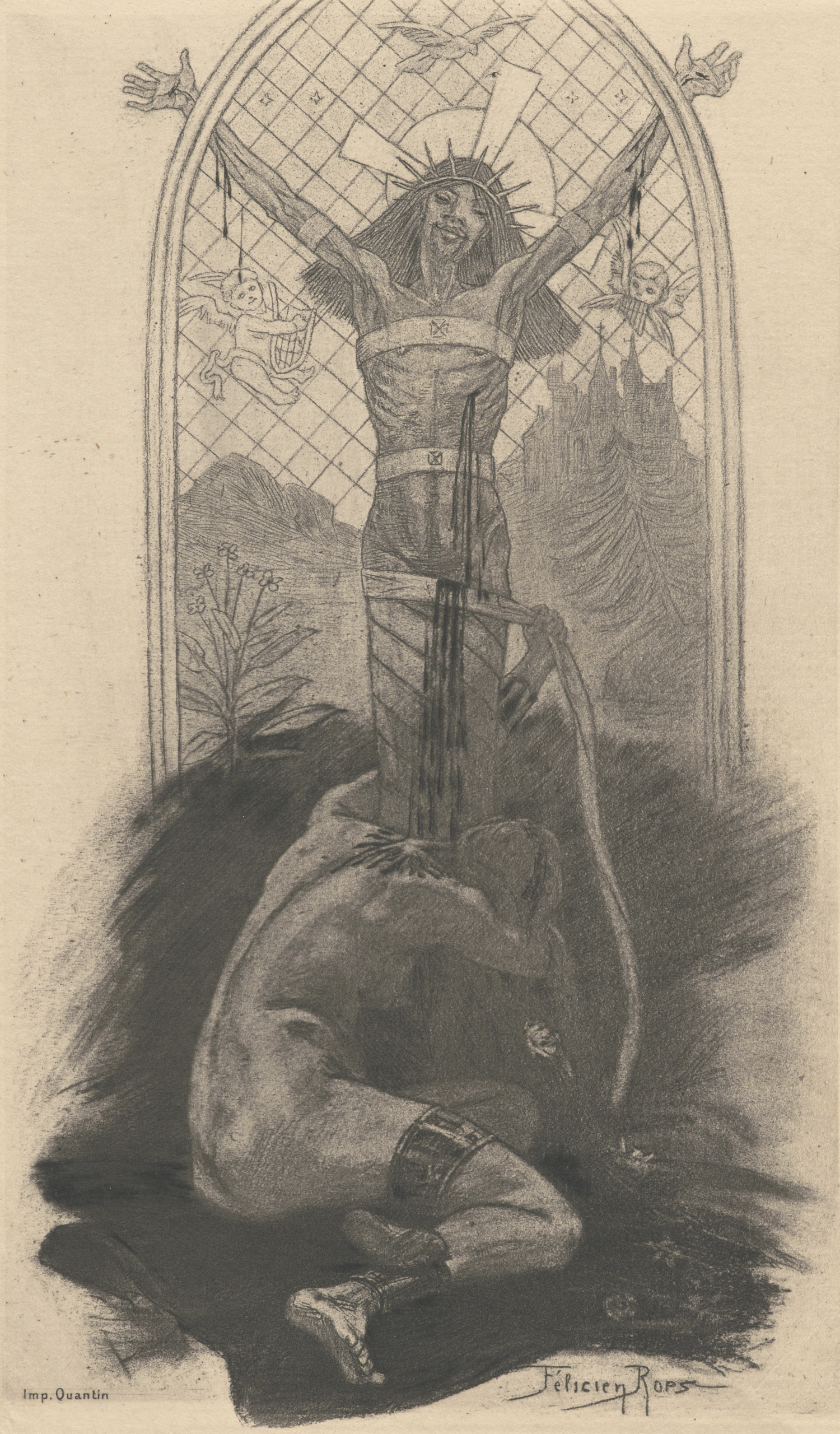
Femme fatale?
Rops’s print L’Amante du Christ (The Lover of Christ) is the frontispiece for the play of the same name by Rodolphe Darzens (1865–1938). The erotic portrayal of Jesus as a woman’s lover caused a scandal in the late 19th century. On stage, Mary Magdalene assumes the role of femme fatale: her spiritual devotion turns into obsessive love. While she may not drive him to the brink of ruin, she does manage to seduce him.
Arnold Böcklin (1827–1901) was another artist who challenged traditional conventions. In his painting, it is not the Virgin Mary who weeps over the dead Christ, but Mary Magdalene!

The saint is unable to hide her overwhelming grief. The painter places her very close to the dead man, so that her gossamer black veil partially envelops his body, brushing lightly against his skin.
Seen from below
Böcklin’s choice of showing the scene from a low-angle perspective draws on a famous model: the roughly life-size Body of the Dead Christ in the Tomb by Hans Holbein the Younger (1497–1543).

In 1917, shortly after his discharge from service as a medical orderly in the First World War, Max Beckmann (1884–1950) painted an enigmatic picture entitled Christ and the Sinner. It shows a group of angry, agitated men with raised fists and lances.
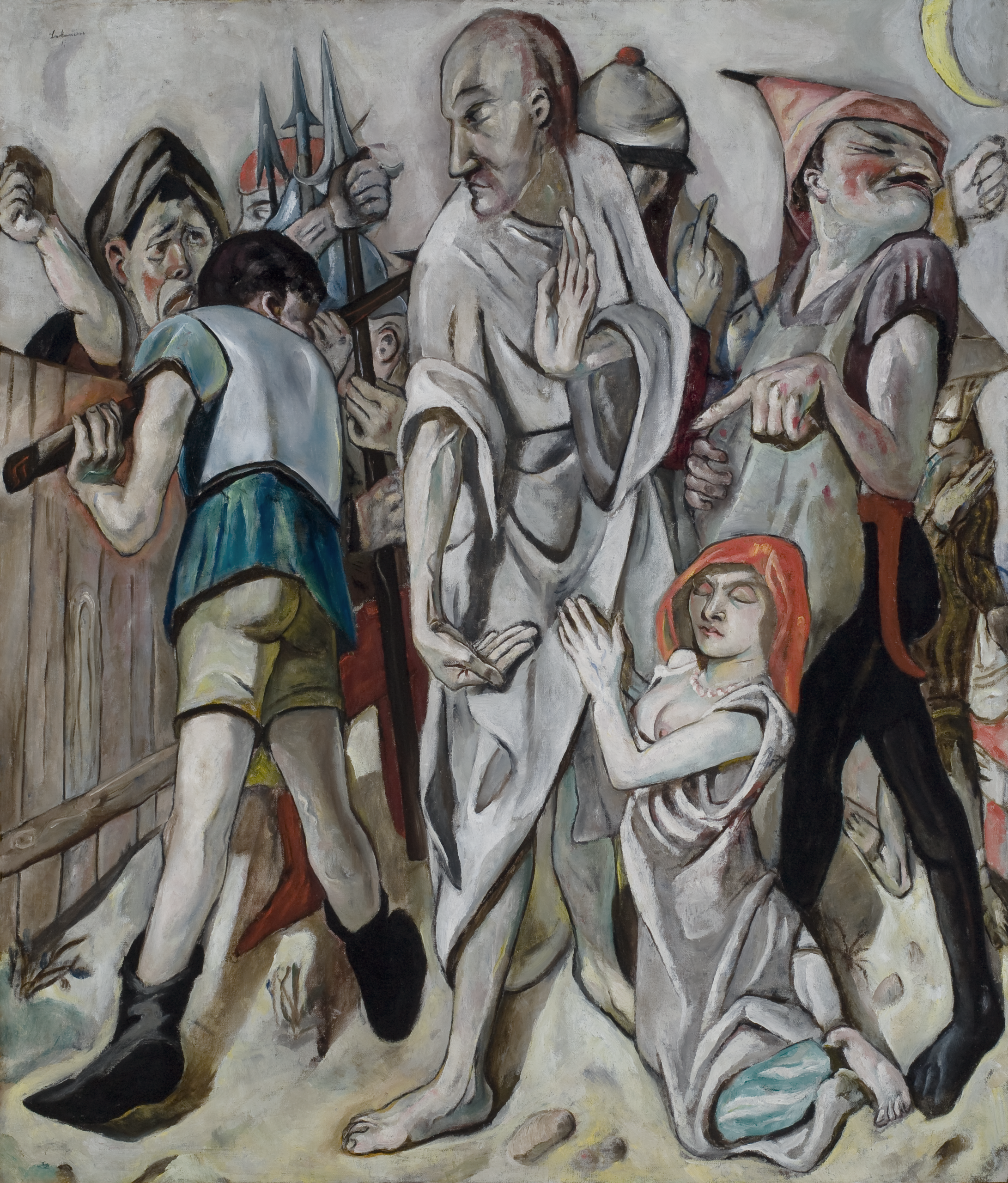
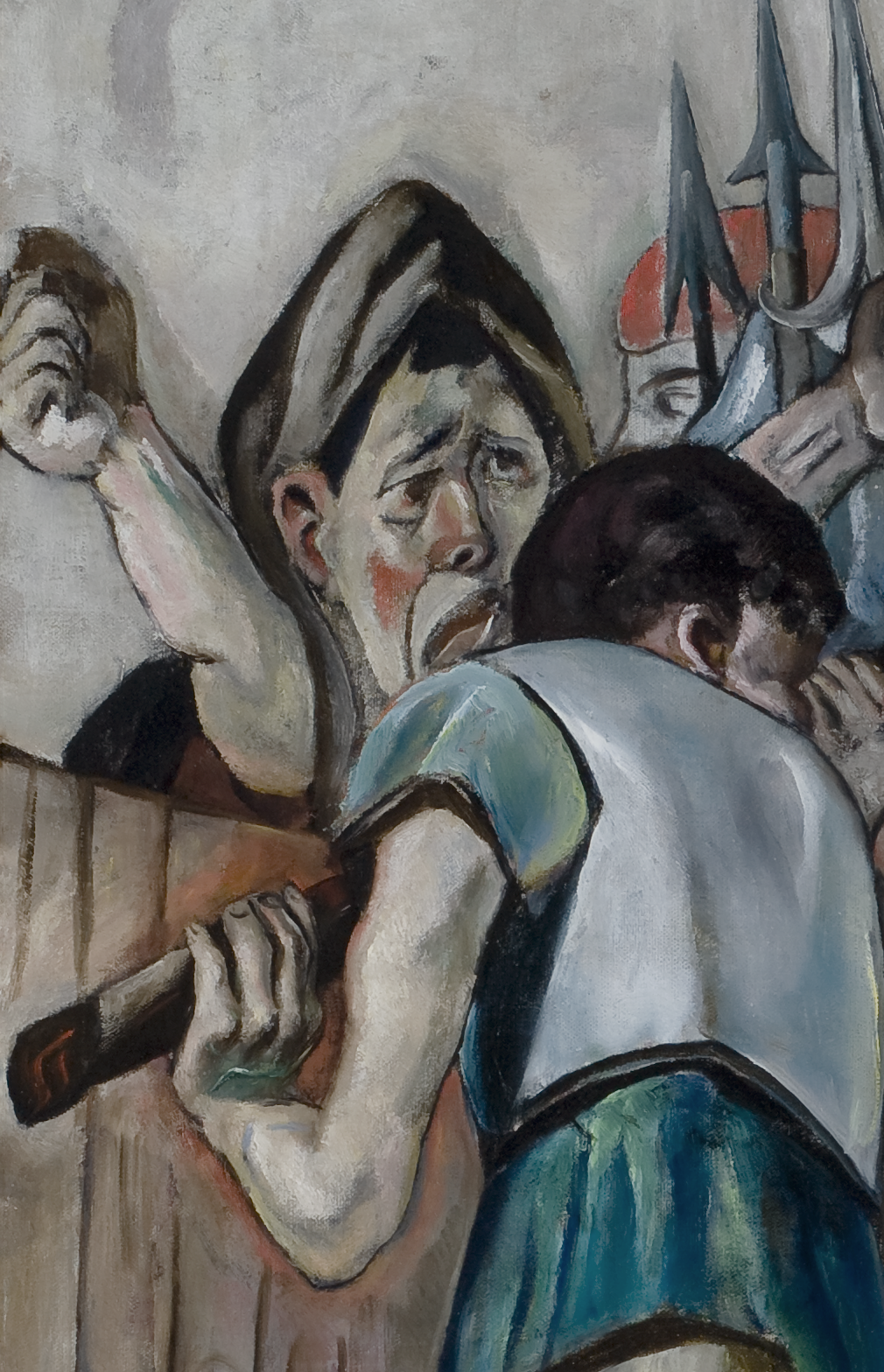
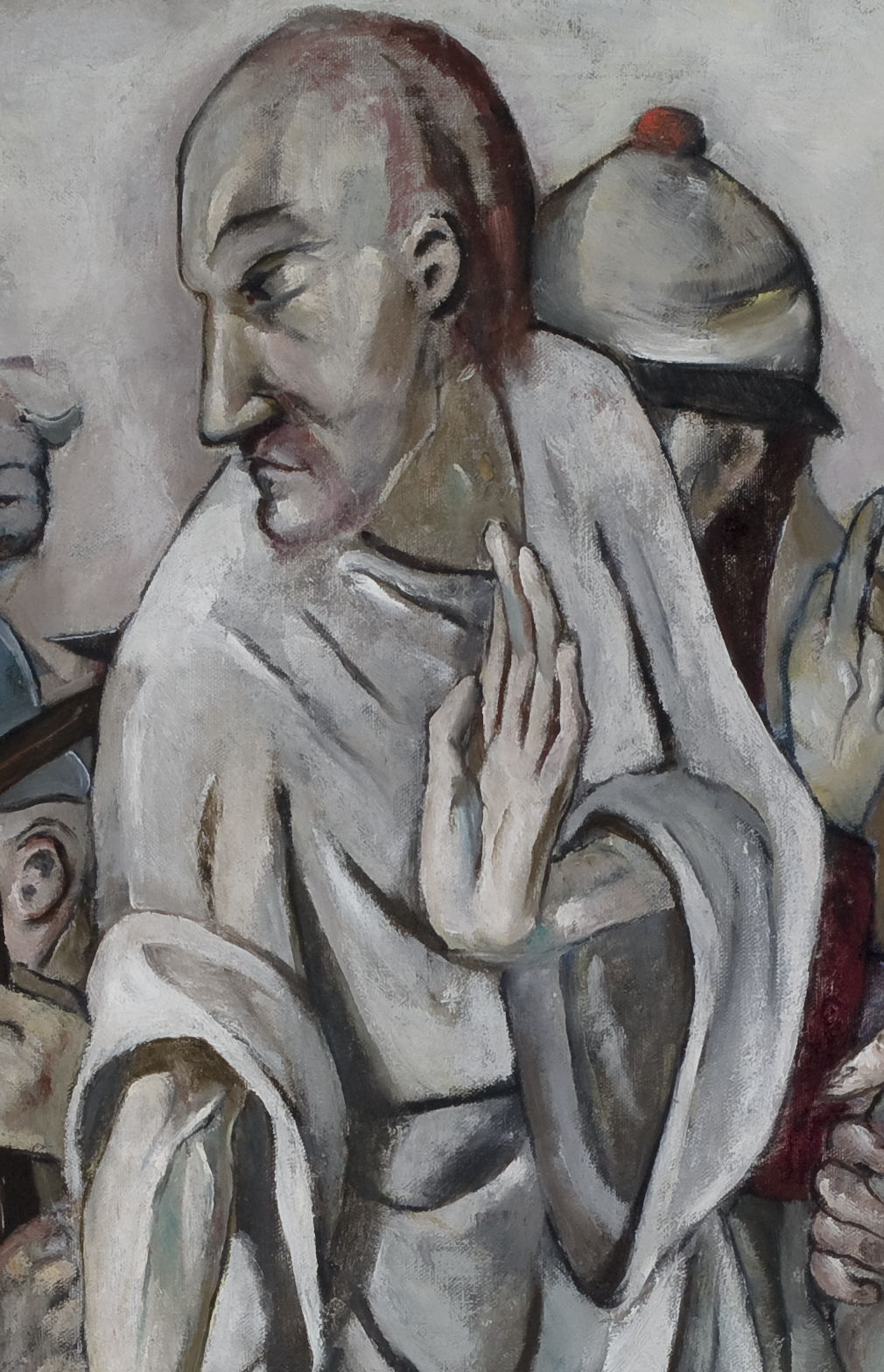

At a time when religious art was becoming increasingly rare, Beckmann’s narrative painting recalls and connects with a tradition of religious images going back many centuries – while still leaving room to reflect on human existential vulnerability.
Make way for the new
Her story may be 2,000 years old – but that doesn’t make it obsolete. To this day, the figure of Mary Magdalene prompts reflection on the role of women. Female artists are especially drawn to probing this subject.
Loyal, beautiful, sinful – long-standing stereotypes and characterisations that are often voiced without a second thought. At the end of the 20th century, however, Mary Magdalene was reclaimed as a powerful archetype of female self-empowerment.
The saint as an invulnerable ideal? Covered in hair from head to toe, Kiki Smith’s (b. 1954) life-size Mary Magdalene recalls the image of the penitent hermit in the wilderness. On closer inspection, however, the surface of the sculpture appears to be riddled with cuts: this body is scarred and vulnerable.
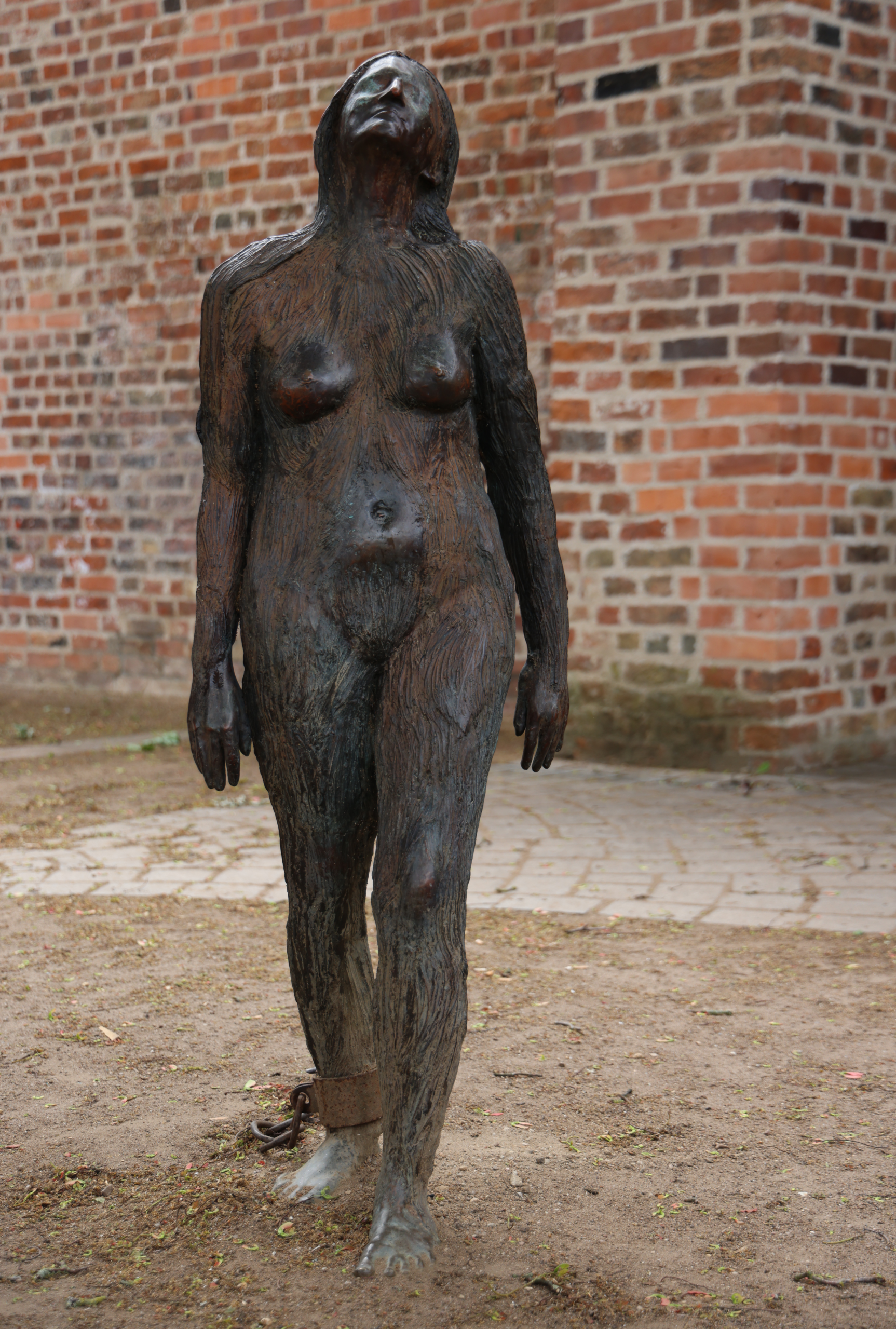
Prominently featured at the base is a broken chain: The sculpture was originally created for the former prison courtyard of Lübeck’s Castle Friary – the saint is also regarded as the patron saint of prisoners. Yet the bound figure’s forward stride may also refer to Mary Magdalene’s liberation from her role as a sinner and penitent, to which she was all too frequently reduced.

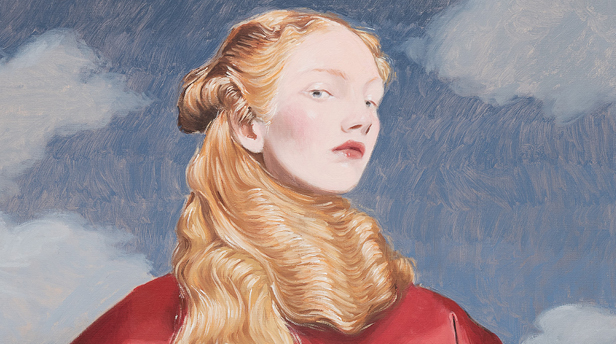
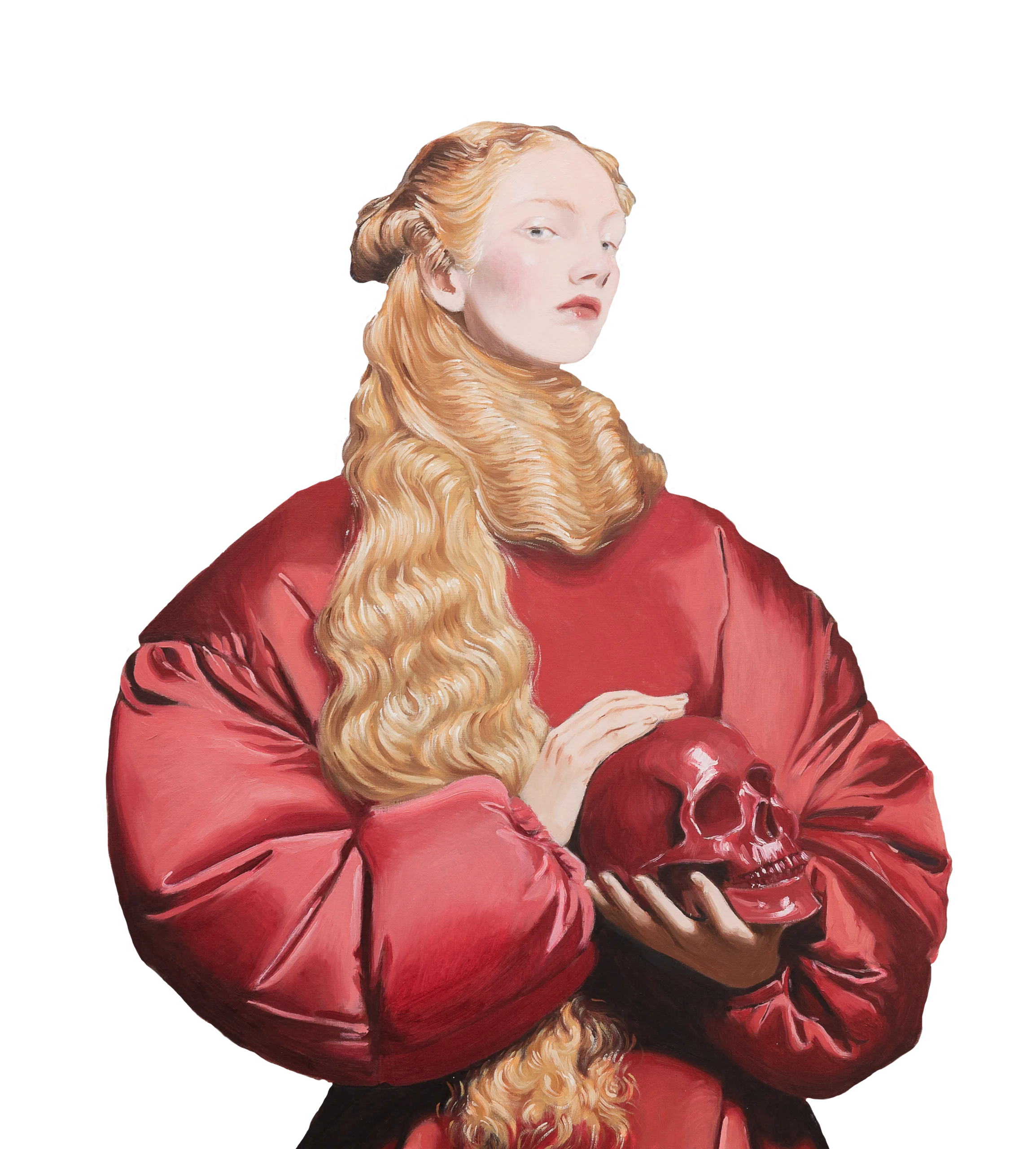
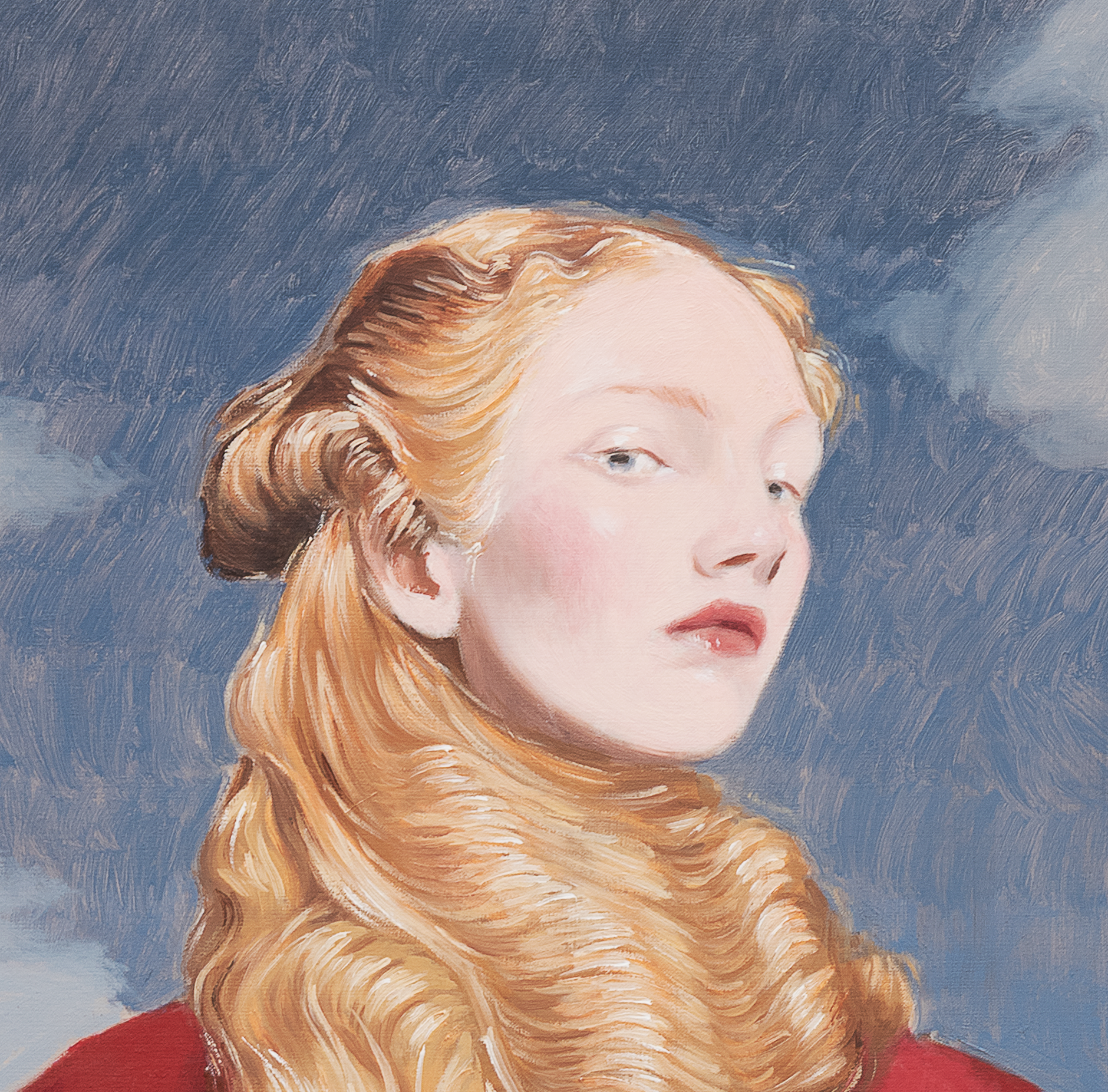
The Spanish artist Nieves González (b. 1996) presents the saint as a young woman with blond hair.

The vibrant red of the voluminous modern puffer coat is traditionally the colour of love, passion, and seduction – but here it comes across as a signal of female assertiveness. Using bold colours and deep shadows, González draws on the visual idiom of Spanish Baroque painting and translates it to the present day.
Mary Magdalene is shown looking down her nose at the viewer with great composure and self-assurance. The artist wants to restore the saint’s powerful presence while preserving a sense of distance and allowing her to regain control of her body, which Christian iconography had increasingly demanded be exposed. The title of the painting, La sfida (The Challenge), hints at a process that is far from complete.
To this day, spectacular discoveries continue to fuel speculation about the “real” Mary Magdalene – the fascination with her remains undiminished.
“Did he then speak secretly with a woman, in preference to us, and not openly? Are we to turn back and all listen to her? Did he prefer her to us?”
Peter, quoted in the Gospel of Mary
The Gospel of Mary (Magdalene)
From time to time, archaeological finds of writings from the Roman period expand our understanding of Christianity. In 1896, for example, a fragment of a papyrus codex was discovered in Cairo, allegedly in a niche of a Christian tomb. Not published until 1955, the Codex Berolinensis Gnosticus 8502 first began to attract wider attention in the 1970s. It contains an eight-page text fragment entitled The Gospel of Mary, which is thought to describe Mary Magdalene’s perspective.
The manuscript, more than half of which has been lost, is thought to be a copy of a text dating from the 2nd century. The narrative begins after the Easter encounter. While in the first part, Jesus speaks to the disciples, it is Mary Magdalene, who conveys his message in the second part. Her important role as a confidante of Christ is confirmed in the text – and met with suspicion by Peter the Apostle.
Such apocryphal texts – biblical or related writings that do not form part of the accepted canon of scripture – continue to give rise to bold speculation: Dan Brown’s bestseller The Da Vinci Code, for example, describes Mary Magdalene not just as Christ’s lover but as his wedded wife.
For 2000 years, the religious and cultural construct that is Mary Magdalene has served as a role model and as a convenient theatrical scrim onto which society, the Church, politics, and the arts have projected their own shifting ideas. Her relevance remains undiminished to this day. Urgent questions of our time are closely linked to how we choose to perceive her: what roles are socially and culturally assigned to women, and what roles are they denied? What does it mean to break free from preconceived patterns and expectations?
Eye catcher
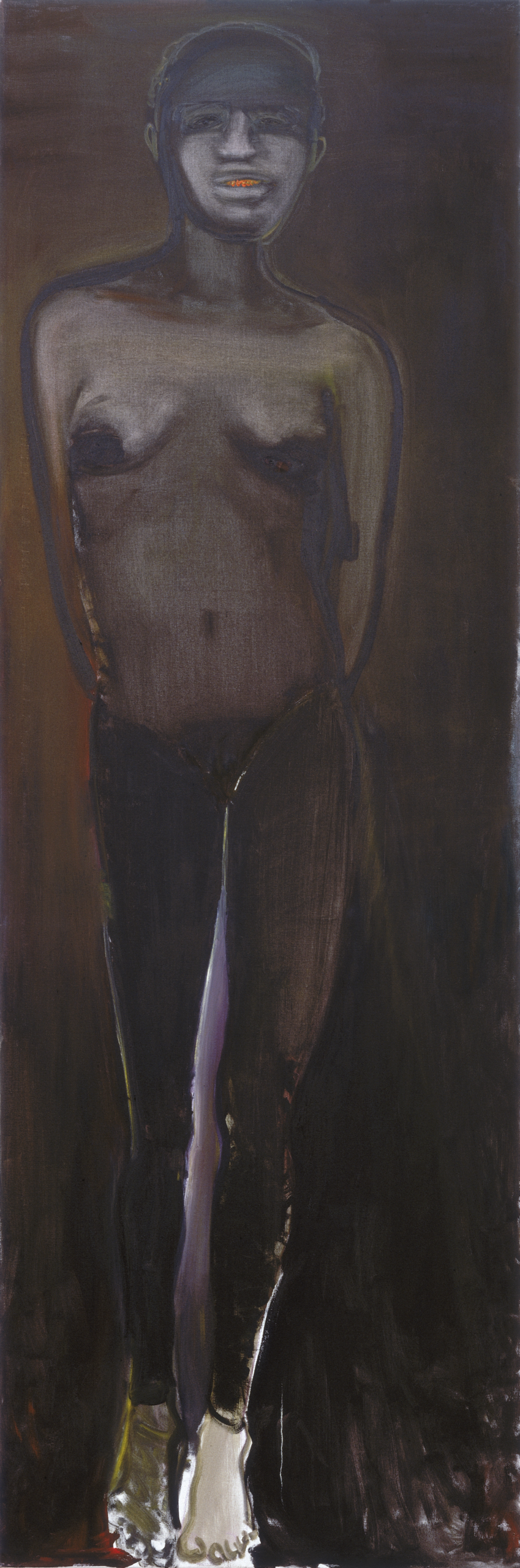
Female figures, standing tall – each different, each unique, each of them titled Magdalena. However, Marlene Dumas (b. 1953) dispenses with the usual attributes of the saint. Instead, her images challenge our clichés of ideal female beauty and question traditional notions of female existence.
Three-metre-tall paintings: Marlene Dumas’s paintings of Mary Magdalene only really come into their own when seen “in the flesh” in the galleries of the exhibition.